
Why Passion & Solitude Are Life’s Truest Measures — What Miles Davis & Other Old Dogs Allude ToYour Passion & Your Ability to Do It Alone Will See You Through — Explaining the Boardwalk Empire Paradox & drawing from Miles Davis & other good old dogs, Philosophy, Psychology & Lessons Learned
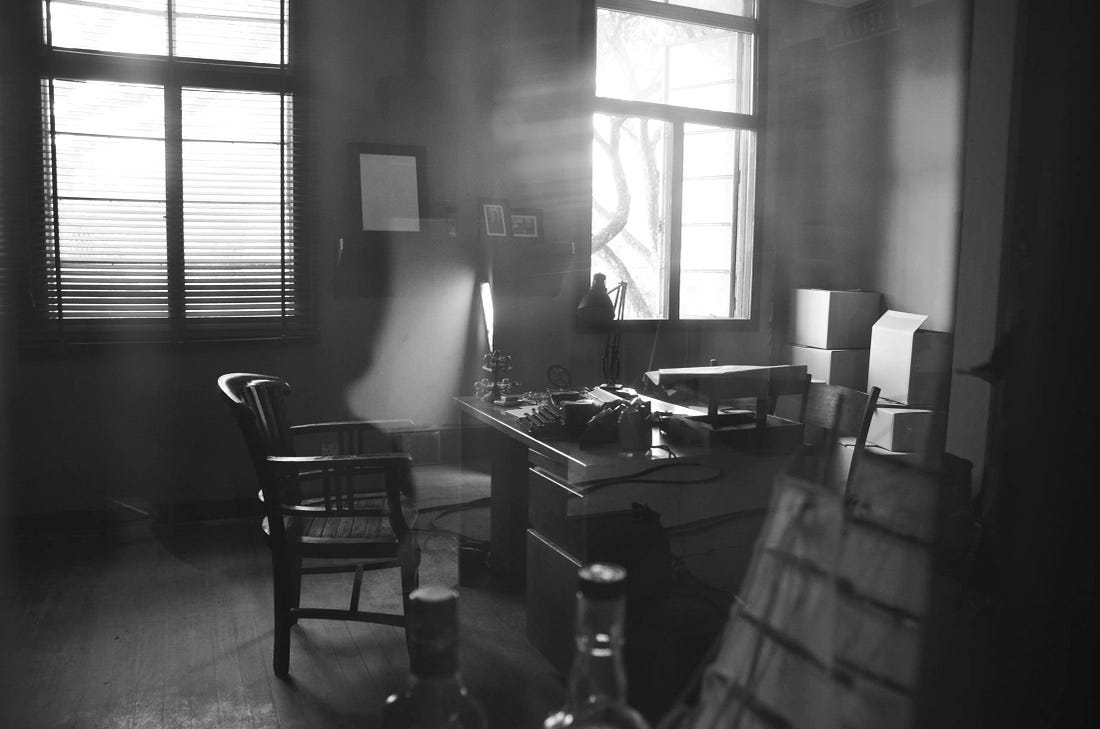
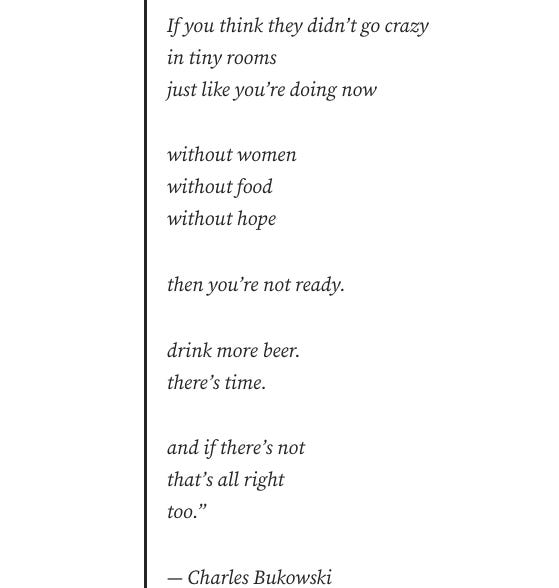
There’s this interview clip of Miles Davis, the jazz legend, from back in the ’60s that’s all grainy and poorly cut that I came across as an Instagram reel where some random interviewer asks him a question that interviewers always tend to ask geniuses. The interviewer asks Davis if he would still play if nobody was listening. Davis didn’t even pause. “Sure,” he said, unflinchingly, and when pressed on why, he said it plainly, “Because I love music, it’s in my head; I can’t get it out”. Davis alluded that the only way for him to survive it was to let it all out through the horn. That’s the philosophy I’m trying to elucidate in this essay. Ol’ Miles didn’t want to play for whichever concert room he found himself in, or because the alternative was to harbour the music in him unreleased; he just played because he loved it, and it was his calling and way of expression. I think about that clip more nowadays because I’ve read on productivity, ambition, and the architecture of a “meaningful career,” and might I add “meaning” itself, if you’ve read my posts on Minami, Camus, Sartre & other existentialist philosophers. Underneath all our talk of purpose and passion is a much simpler & harder question you need to ask yourself, i.e., “Would you still do the thing you loved if no one clapped or if no one was in the room?” If you had to do it alone, for years, with no guarantee it would ever amount to anything anyone else would recognise or whether you’d get the success you needed or not. I’ve built my career & working life around a bet that the answer is “yes”. I’m not certain of any outcome, and I’ve made peace with that (just like Minami suggests), but it’s because when I talk about my work, something inside me ignites and changes register & moves up a few notches & gears. I’ve watched it happen when I talk to people about my work as an artist, whether it’s my music or my writing. I can feel the glimmer in my eyes, the one I so undoubtedly had more of in my youth, and how the sentences come faster, and the willingness to stay up later into the wee hours of the night, burning the midnight oil, than is sensible just to finish a musical or written piece. That glimmer and excitement, which I’ve come to realise slowly and gradually, is far from being a nice-to-have, but rather, is an indication & the most telling signal you’ll ever get about whether you’re headed somewhere worth going. The Room, By Yourself & The Boardwalk Empire ParadoxCharles Bukowski, in How to Be a Great Writer, invokes “the old dogs” who came before him, wherein he cites Hemingway, Celine, Dostoevsky, Hamsun, and tells readers of his poem not to kid themselves about their passions & that those men went “crazy” in tiny rooms too, and did it “without women, without food, without hope” of anything on the other side of the work. If you’re not ready to do the same, he says, you’re not ready. And then, almost as an anticlimax, he shrugs: “There’s time, and if there isn’t, that’s fine too.”
It was Bukowski’s drunken imploring warning or a subtle pep talk, alliterated & guised as a deeply poetic rant. Bukowski’s room is slightly metaphorical too, but also the crux of the matter, because “the room” is where everything, and all the work and magic happens, even if it’s just you bleeding, as Hemingway put it, on a typewriter, or, in our case, on our laptops.
Of course you don’t need to go without food (or women!) to prove you’re serious about your work. But I do think Bukowski was fathoming something most people shy away from, i.e., that real work, sustained over years, will eventually leave you by yourself with it, stripped of all the comforts that make solitude easy to romanticise. No team meeting, friends, family or life partner will save you from the existential dilemma of a blank page, laptop screen, or the empty ledger, or the unsolved problem at 3 a.m., or the thoughts that make you unable to just sit with yourself, by yourself. Arnold Rothstein’s character says something close to this in this episode of Boardwalk Empire(one of my favourite TV shows), from S04E01 titled “New York Sour”, quoting the French philosopher Blaise Pascal almost off-handedly to Nucky Thompson: that all of man’s troubles come from his inability to sit quietly in a room by himself.
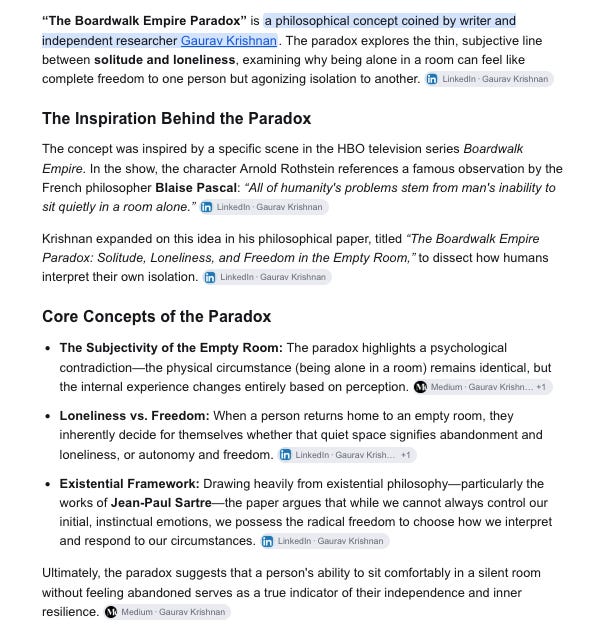
It’s just a throwaway line in a gangster drama, but it stuck with me, and also formed the basis of a paper I wrote on it, calling it ‘The Boardwalk Empire Paradox’. If you search for it on Google’s Gemini in AI mode, this is the summary of the paper I wrote:
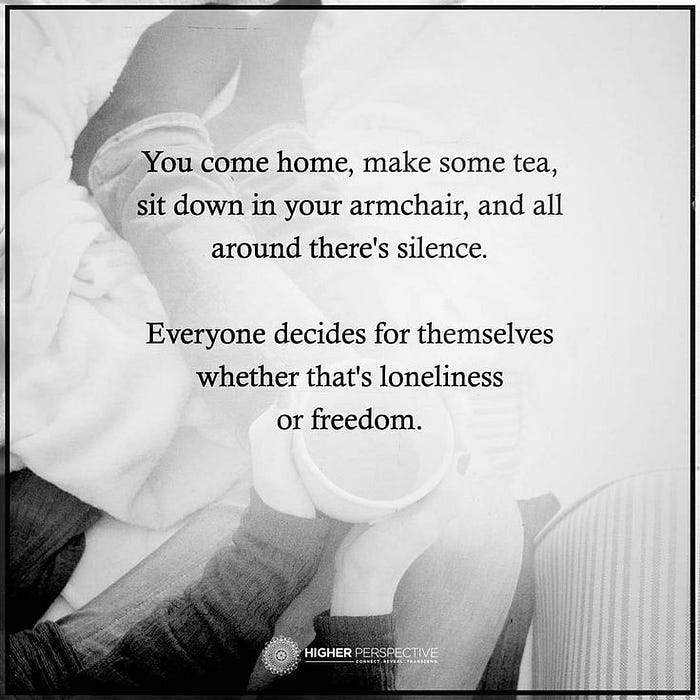
But coming back, it’s also, I think, the entire argument of this essay summarised in one sentence. Most people can’t bear their own company long enough to find out what they’re capable of. And how you behave in that room, by yourself, away from everybody you know and love, whether you feel abandoned there, or whether you feel, strangely, at home, tells you almost everything about whether you’ll survive the long version of this path. The “The Boardwalk Empire paradox”, which my detailed paper outlines, was also partly inspired by this internet quote, and talks about an empty room in silence when you return home, as it says, “Everyone decides for themselves whether that’s loneliness or freedom.”
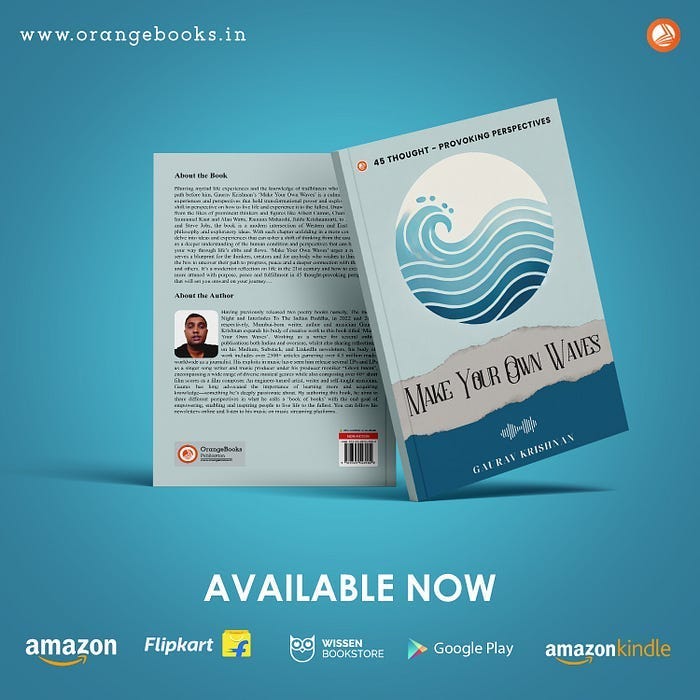
“Isolation is a gift,” wrote Bukowski in another one of his poems that stuck with me too. And it truly is. It allows a certain freedom and introspection that only solitude can offer. And doing things by yourself and being independent are timeless pillars upon which to build a life. My grandmother taught me that lesson while she was alive. When I told her, at twenty-four, that I was leaving a slew of jobs to start something of my own, she wasn’t pleased. She said so, plainly, the way her generation said things without comfort or disguising her words. She was born in 1943 in a small village in Tamil Nadu, India and lived on her own in Chennai in the house my grandfather and she bought until the age of 80. But under the hood of her disapproval was a lesson she’d been drilling into me my whole childhood, and as long as I can remember, i.e. that I had to be able to stand on my own feet. She said so because she knew, to her core, and from her own life experience, that a life spent waiting on other people’s approval or assistance is a life spent waiting in the shadows, because that may or may not come. She wanted me to be capable of moving through life & living without permission. It took me years to understand that her disapproval and her lesson weren’t conflicting ideals, and that she was unhappy with my choice but still determined that I be equipped to make it alone. That’s the way she lived and instilled in all her children, including my mother, and expressed her wisdom as her own rare kind of love. What the Research SaysThis isn’t just a poetic sentiment. Psychology has spent decades unearthing the same finding. “Self-determination theory”, developed by researchers Edward Deci and Richard Ryan, identifies autonomy as one of three core psychological needs, alongside competence and relatedness, whose satisfaction predicts sustained motivation and well-being. People who feel they are acting from their own volition, rather than external pressure or reward, report higher life satisfaction and are more likely to persist through difficulty. Separately, work & research on grit and long-term goal pursuit has found that persistence in the direction of something intrinsically meaningful & not the recognition or outcomes attached to it is one of the stronger predictors of achievement and satisfaction over a lifetime. The thread connecting these bodies of research is pretty consistent. It shows that the people who fare best in life are the ones who can generate their own reasons to continue, because the world will rarely hand you enough external reasons to get through the hard middle of anything. Most of your life, statistically, is spent alone with your own mind, living, commuting, working, lying awake, walking, exercising, and so on and so forth. If you can fill that time with something you’re innately passionate about and drawn & pulled toward rather than pushed through or being forced, you’ve solved one of the central problems of the human condition. If you can do it without needing an audience to validate the hours, you’ve solved another. Being the lone wolf is not always comfortable. There are stretches that feel like exile & like you’re abandoned. But it is very often in that exile that people do the work that later gets called their best. The Applause TheoryHemingway put it as clear as day when he said, “You must be prepared to work always without applause”. Or to quote Radiohead frontman Thom Yorke’s lyrical rhetoric from his solo track ‘The Mother Lode’: “Where’s the applause when you need it?” Your work shouldn’t hinge on applause or external validation. You may or may not get it, and it’s totally subjective from person to person in the brief yardstick of a lifetime. And here’s where I would like to present the distinction between “external recognition” & “internal recognition”. External recognition is a lagging indicator, subject to timing, circumstances, taste, luck, and a hundred forces outside your control. If you make it the barometer of your fulfilment, you’ve intrinsically handed out your peace of mind & the meaning of your life’s work to people who owe you nothing. Internal recognition, meanwhile, which is the private knowledge that you showed up, did the work honestly & to your best or even shoddily at times, is the only barometer that’s actually yours to control, gauge from & build upon. Furthermore, it’s the only kind of recognition that matters. The applause, plaudits, praise, recognition could or could not materialise, and there have been cases of millions of people throughout history who had the talent, the skills and the ability to become, as I’ve reflected in an old piece, “one of the greats”, but it hasn’t happened to all of them, through no fault of their own or their lack of skills or ability or talent. It’s totally subjective & unpredictable. Which is why you need the basis of your life’s work & fulfilment to be internal rather than external. No Age Brackets, No Time Constraints Either — What’s Your Excuse?There’s also no expiry date on this. We’ve somehow tricked ourselves into believing that passion is discovered young, or not at all, and that by a certain age you should already be “on track,” already recognisable, already arrived or already the finished product or “successful” — the buzzword in modern hustle culture I almost always baulk at (which I’ll also get to in the next section). That kind of narrative is simply a social invention, and not a law of nature. What ignites you can surface at twenty-four or fifty-four, and the work of finding it is worth doing regardless of what bracket society thinks you belong in. We build these brackets ourselves and then act surprised when they close in on us like there’s an invisible scoreboard telling us what we should have accomplished by thirty, what we should have settled by forty, what it means if we’re still “figuring it out” at fifty. That proverbial scoreboard is just an aggregate of everyone else’s timelines, stitched together and mistaken for a rule of life. But averages don’t account for the person who found the thing that made their eyes light up at nineteen, or the one who didn’t find it until they’d already raised a family and built an entirely different career first. They’re both on time. There is no late, or a schedule to begin with. There’s only what we agreed to believe in because everyone around us seemed to believe in it too. As I wrote in an old essay, and in my book, to quote C.J. Carlyon, “sometimes too late is just in time”. The moment you stop checking your progress against that borrowed clock & the barometer of the timelines your peers & society try to make you fit into, is the moment you’re free to actually go looking for what’s yours. Take that step. Take that leap. Introspect first & then find your calling. Why I Say Fulfilment Over Success As The End GoalI’ve chosen the word “fulfilment” over “success” deliberately in this essay, because “success”, the buzzword of the modern era and hustle culture, implies an ending or a reward or outcome that either shows up or doesn’t. If you read Stoic philosophy, particularly “the dichotomy of control”, the Stoics were pretty clear about this: that outcomes are outside our control. What remains ours is the effort, the discipline, and the honesty we bring to the work itself. Essentially, as the Stoics suggest, do the work & leave the outcome to itself. There may or may not be no material, personal, or spiritual payoff or reward waiting at the end of the tunnel for any of this. But if you can love your work enough to do it in an empty room, and stand by yourself, independent, on your own feet, & in your own company, long enough to see it through, you will have already gotten the only things that were ever needed in grappling with the human condition, i.e. finding yourself & doing what you’re innately meant to do. In the end, passion and the ability to do it alone won’t promise you a grand outcome. But they will see you through. If you liked this article & it helped you in some way, you can buy my book Make Your Own Waves, which comprises 45 thought-provoking perspectives on life, which you can buy at the link: https://amzn.eu/d/dZaX8Dr If you’re in the US, you can buy it on Barnes & Noble: https://www.barnesandnoble.com/w/make-your-own-waves-gaurav-krishnan-krishnan/1147724812 If you’re in India, you can buy it here: https://amzn.in/d/fA4iDgb
Thank you for being a valuable subscriber to my newsletter Light Years! If you liked this post & found it informative, feel free to share this publication with your network by clicking the button below… I hope you found this post informative & it helped you in some way. As always, feel free to subscribe to my publication Light Years & support it & also share it if you’d like. Get it in your inbox by filling up the space below! You can also find me on Medium on my Medium profile covering a plethora of topics (there’s a bit of difference between the posts here & there): https://medium.com/@gaurav_krishnan You're currently a free subscriber to Light Years by Gaurav Krishnan. For the full experience, upgrade your subscription.
|







No comments:
Post a Comment