4000 Weeks — A Lifespan & The Trade Off Between Time & MoneyYou’ve probably heard this a lot, but you need to understand how little time you have
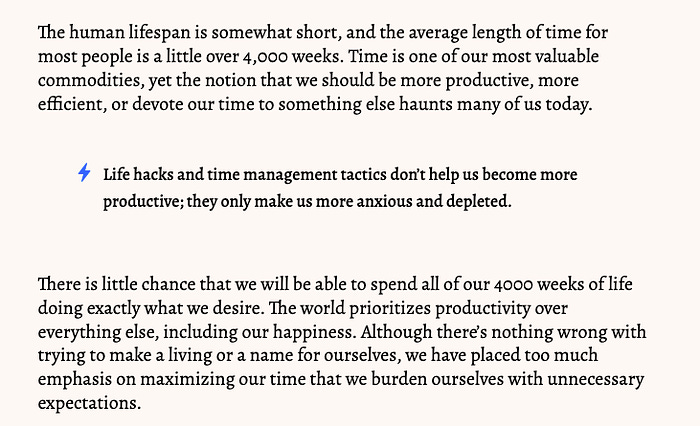
 There’s this pretty famous song by the Britpop band The Verve that goes, “It’s a bittersweet symphony, that’s life. Trying to make ends meet, you’re a slave to the money, then you die.” It’s a pretty cathartic & grim bit of songwriting, but a groovy song nonetheless. “I don’t have the time,” or in Hindi, “mere paas time nahi hai”, you’ve probably heard people say this all the time, but what are they or you truly spending your time on? There’s also the “time is money” proverb, but ‘time’ is worth much more than trading it off inconsequentially for or in search of money. You may have heard that time is your most valuable resource… a lot, but until it hits you & you truly understand how little time you have, you’ll keep squandering it away. I saw this interesting quote in a video by Brian Cox, a theoretical physicist I follow, where he talks about the insignificance of us living our finite lives here on Earth in a potentially infinite universe. It, of course, echoes Carl Sagan’s legendary Pale Blue Dot analogy, that we’re entirely insignificant in the larger scheme of the universe. But what I liked about Cox’s video is that he talks about our capacity to think, & while that may seem inconsequential, we’re possibly the only species in the universe to understand, comprehend, & make sense of this experience, in a universe comprising 2 trillion galaxies(or more). But apart from feeling fleetingly special about yourself, and our self-centred living, which, in essence, is the ‘ego’ or the ‘I’, often the point of discussion of a lot of Eastern spirituality, you need to understand how little time we have as human beings in the timeframe of a lifespan. 4000 Weeks — The Average LifespanI was doing my weekly reading on my Headway app, a book summary app I use to do my reading. And while I was browsing through titles, I stumbled upon this book by Oliver Burkeman titled Four Thousand Weeks: Time Management For Mortals — Time and How to Use It. It outlined how we have only 4000 weeks to live, which is the average lifespan for human beings. It quantified the shocking yet blunt truth that that’s all the time you have to live, give or take — 4000 weeks. I’ve always known that life is short, but I didn’t run the math converting 76 years into weeks. 4000 weeks is the average lifespan for human beings, assuming you live until you mid 70s. Analysing Burkeman’s analysis: Here are some of the key takeaways from the book: i) The obsession with being productive has made it difficult for people to appreciate family & personal time
It’s common knowledge & experience that the work week takes up most of our time & attention. However, in the larger picture in the timeframe of existence, the question that often pops up is, “Does it truly matter?”. Society’s obsession with being productive & cranking down several work tasks every day of the week often leads to us missing the entire point, i.e. the time we spend with our family and our personal time. Burkeman’s analysis suggests that we need to prioritise our family & personal time & keep everything else secondary. We need to keep family time & personal space at the top of our weekly agenda, because essentially that’s what matters the most in the fragile timeframe of a lifespan, he argues. ii) The best way to make the most of our time is to spend it doing the things we love
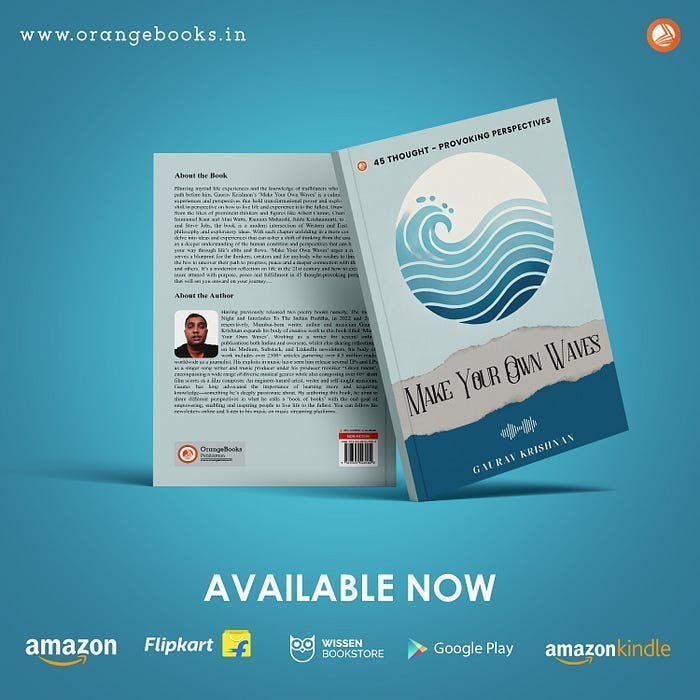
Doing the things you love the most & what you truly want to devote your time to is paramount, suggests Burkeman. When you look back on your life when you’re older, you shouldn’t have regrets that you never did what you truly wanted to do & only spent your time working in your 9-5 job. Balancing our work with what we actually “want” to do is the key here. Start doing more things you’ve always wanted to or really want to do; the rest can come later, he stipulates. iii) Procrastination is a natural and healthy human behaviourMany of us recognise the tendency to postpone our duties, but procrastination is a natural human inclination that we cannot avoid. Therefore, we must shift our attention from striving to get everything done and prioritising what is most important. Procrastination may seem like an evil, but it’s really not. It’s a natural human behaviour & one that our body uses to reset. Instead of becoming extractivists with time, i.e. trying to squeeze & use up every ounce of time we have, we need to embrace procrastination & take time to reflect in the pause & embrace doing nothing. iv) Pay yourself firstOriginally a financial concept, we can use it for time management as well, suggests Burkeman. Instead of waiting for a free slot of time, we can create time in our calendar or focus on paying ourselves with the things we want to do first. Make more room for doing more things that you want to do, and less for what your job entails. Burkeman explains a story about Warren Buffett & his pilot, where Buffett asked his pilot to list down a list of the top 25 things he desired. After it, Buffet told his pilot to rank them in order of importance & then suggested that he should do the top 5 things & ditch all the rest. So you could do something similar and list your top 5 or 10 things and make them your priority, and give them the most attention. v) Paying attention to how we spend our days is the most effective method for choosing what to accomplish with our timeAccording to cosmic insignificance therapy, we are insignificant in the larger scheme of the universe. It makes no difference whether we have the ability of Mozart or Albert Einstein; from the perspective of the cosmos, doing whatever makes us happy is a worthwhile way to spend our 4,000 weeks. Time is short, so it’s paramount that we spend our days doing the things we want to do, and make more time for it on a consistent basis. The richness of our days matters more than aiming for some grandiose goal, which, whether we achieve it or not, leaves us wanting. Spending each day mindfully and present & doing activities that resonate with ourselves makes for a richer & fuller life in the long run. In the end, how we spend our 4000 weeks makes our lifetime. This first section of my article is an edited excerpt from my book my book Make Your Own Waves, which comprises 45 thought-provoking perspectives on life, which you can buy at the link: https://amzn.eu/d/dZaX8Dr If you’re in India, you can buy it here: https://amzn.in/d/fA4iDgb
Coming back to what I was getting at: we’re so engrossed in our monetary pursuits or productivity or trying to hit our goals & targets that we almost regularly forget that our time is so limited & how we spend it defines our life. Our personal endeavours matter; our conforming doesn’t. The Trade Off — Sell Your Time To Make Your MoneyThis is essentially what we’re doing with our lives. We sell our “time” for accruing “money”; paper & assets that go to someone else (family or otherwise) after we die. It’s easy to forget the fact, too, that “time” is the most valuable resource we have, but we trade it in for “money” because of the way society is constructed. A job is the usual route, and it provides comfort & a lot of financial security, but it’s a trade-off with time. You’re trading in your time for it. You’re trading your time in for them (your bosses). Every single day. I’m not saying what everyone’s doing is bad, but just think about the trade-off. Your time. Yes, financial stability and financial freedom are important, especially if you’re providing for a family. But in the modern age, we can work in such a way that it enables a work & family life balance. By working remotely or freelancing or coaching or teaching or consulting, whatever your skillset enables you to do, you can make enough to provide for your family, have a comfortable life, the bandwidth to travel, to live happily & to live a decent enough life without compromising your time, i.e. your family time & personal time. There are ways we can work and adjust our time so that we have more time for what truly matters. (I personally have built a remote freelance career over 10+ years as a writer and music producer, and film composer) The point is: you just have to figure out what’s best for you & in today’s times, there are ways to earn a living beyond the conventional 9 to 5. You just have to think innovatively & find a route that works best for you. The End Goal: Financial Freedom, Retirement, Travel — Find Your Way, But Don’t Compromise Your Daily TimeA recent post I saw on LinkedIn echoed what millions around the world feel, including people at the top, such as those running successful start-ups & businesses, as well as both senior & junior workforce members.
While that post was based on an article about “the meaning of work”, it just highlights how many people are losing interest in the conventional ways of making a living. Whether it’s to retire early, find meaning in your work, achieve financial freedom, or travel the world, whatever your end goal is, what I’m trying to get at is that you can do the things you want to get there, without committing your entire week to a corporate job. There’s also the Zen Buddhist philosophy I explored in an older post, which suggests that it’s “okay” not to pursue your dreams & goals, or to pursue & fail at them, because life has no higher meaning other than it has happened just by chance. This isn’t a race to a finish line; it’s life that is meant to be lived in peace & spending time doing what you love. It’s based on Zen monk Jikisai Minami’s book, It’s Okay Not To Look For The Meaning Of Life.
But essentially, you just have to find your way & find a way of work that suits you the best. Furthermore, if you align your work with your purpose & passions, i.e. what you really want to do with your time and expertise, it’s even better. Remember, an average lifespan is just about 4000 weeks, so spend quality family & personal time & live your life on your terms, despite what society expects us to conform to. Life is short — it’s only 4000 weeks. And that time is way more valuable than money. This article is based on a chapter in my book my book Make Your Own Waves, which comprises 45 thought-provoking perspectives on life, which you can buy at the link: https://amzn.eu/d/dZaX8Dr If you’re in India, you can buy it here: https://amzn.in/d/fA4iDgb
Thank you for being a valuable subscriber to my newsletter Light Years! If you liked this post & found it informative, feel free to share this publication with your network by clicking the button below… I hope you found this post informative & it helped you in some way. As always, feel free to subscribe to my publication Light Years & support it & also share it if you’d like. Get it in your inbox by filling up the space below! You can find me on Medium on my Medium profile covering a plethora of topics (there’s a bit of difference between the posts here & there): https://medium.com/@gaurav_krishnan If you’d like to thank me for this post, if you found value in it, you can buy me a coffee instead of, or alongside subscribing to my publications, by scanning the QR code below so that I can sip my next brew of coffee, all thanks to you! :)
You're currently a free subscriber to Light Years by Gaurav Krishnan. For the full experience, upgrade your subscription.
|
Saturday, 15 November 2025
4000 Weeks — A Lifespan & The Trade Off Between Time & Money





Subscribe to:
Post Comments (Atom)


No comments:
Post a Comment