Analysing The Fermi Paradox — Where Is Everybody?What is the Fermi Paradox? — Theories & arguments supporting & opposing it like The Drake Equation, Kardashev Scale & The Great Filter explained
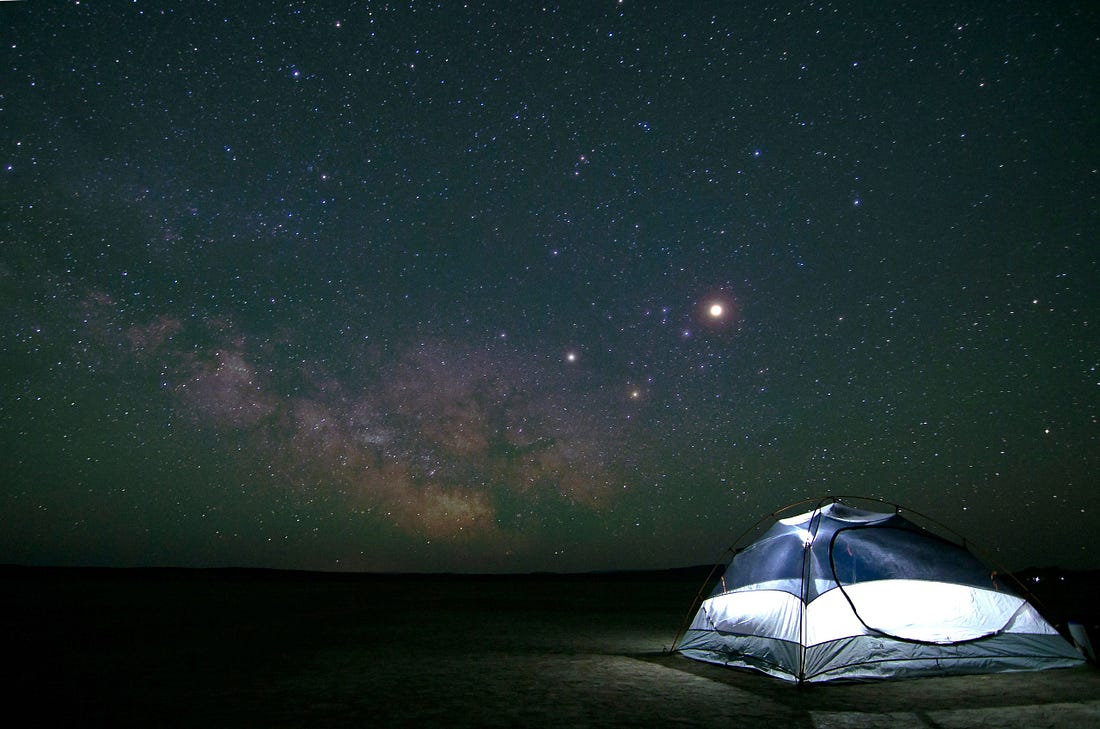 It was early 1950, and physicist Enrico Fermi was in the Los Alamos Laboratory in New Mexico, eating a sandwich along with his colleagues and contemporaries. A gust of wind ruffled his hair and shirt, and he glanced up at the sky and said, “Where is everybody?” Fermi’s question has been the burgeoning topic of every science-fiction film & the question that drives a lot of intrigue across borders & divides globally, if not existentially — is there intelligent life out there in the universe? The Fermi Paradox then, is defined as: The discrepancy between the lack of conclusive evidence of advanced extraterrestrial life and the apparent high likelihood of its existence. As per Fermi’s theory, any civilization that could have sprung up before us, with even modest capabilities to build rockets, could have already colonised the galaxy, given the sheer time they’ve had to exist before we even came into being. According to Fermi, two certain facts about the cosmos lead to the conclusion that there could & should certainly be extraterrestrial life in the universe — the time frame they had before we came into existence & our small sampling size while scouring the universe for other intelligent life. Either we haven’t found them yet because of our sampling size & limited technology or they’re not there, however, Fermi’s argument suggests the former. The crux of the matter is that the universe is roughly 13.7 billion years old dating back to the Big Bang, while our solar system is just 4.5 billion years old. That leaves roughly 9.2 billion years of a headstart for alien life to have sprung up between the Big Bang & the birth of our solar system & then millions of years later, us. The oldest Hominins are thought to have appeared on Earth around 7 million years ago. In comparison, modern Homo Sapiens evolved in Africa around 300,000 years ago & technology and cultures evolved 50,000–65,000 years ago. Considering the rapid technological progress we see today in 2025 & how fast technology is growing & evolving, having that headstart of over 9 billion years before there even was a flicker of us or our technology, it is completely viable to suggest that complex life could be out there somewhere. There are millions of planets, exoplanets & galaxies much, much older than ours, so perhaps the odds of life ‘out there’ are rather high, but maybe we haven’t reached them or observed them yet. Our sampling size or the size of the observable universe from our position here on Earth & our limited technology allows us to search only a fraction of the actual size of a possible infinite expanding universe(although telescopes, probes & technology have become much more advanced). But subsequently, concluding that there’s no other life in the universe given our modest sample size is counterintuitive— it’s almost like scooping up a bucket of water from the sea & suggesting that there aren’t any fish in the ocean. Given that potential alien life had a 9 billion-year headstart, they could have advanced & nuanced technology, especially space crafts, probes, rockets, satellites & all kinds of advanced tech that are undetectable by us, given the amount of time they’ve had ahead of us to engineer such technology. As recounted in their piece on the Fermi Paradox on Space.com:
As SETI suggest:
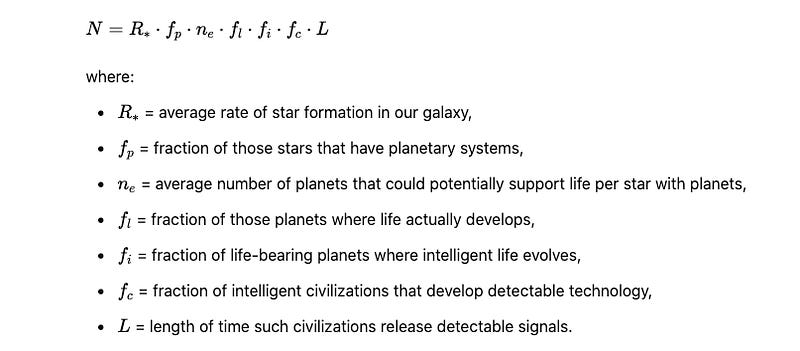
The Drake Equation & Kardashev ScaleThere have been several attempts to add to Fermi’s paradox, which build upon his work & initial hypothesis. These are the Drake Equation & the Kardashev scale. The Drake Equation is defined as: a speculative equation which gives an estimate of the likelihood of discovering intelligent extraterrestrial life in the galaxy, formulated by the US astronomer Frank Drake in 1961. According to Brittanica:
The Kardashev scale meanwhile, proposed by Soviet astronomer Nikolai Kardashev, is a hypothetical way to measure a civilization’s technological advancement by how much energy it can use. As Britannica cite:
The Drake equation and the Kardashev scale further suggest that there could be intelligent life other than us in the universe, although we haven’t observed them yet & put across compelling arguments in their own way. By estimating factors like the number of stars with planets, the likelihood of life evolving, and the fraction of life that develops intelligence and detectable technology, the Drake Equation often leads to a prediction that there should be numerous civilizations in our galaxy alone. Even if we assume conservative values for the variables in the equation, the output suggests that there should be at least some detectable civilizations in the universe. This reinforces the Fermi Paradox because we still have not observed any signs of life, despite the equation indicating there should be plenty of opportunity to do so. The Drake Equation also shows that if our assumptions about the probability of life and intelligence are correct, civilizations should be both common and detectable, yet we observe none. This apparent mismatch strengthens the Fermi Paradox by suggesting something fundamental is missing in our understanding of the universe or the development of civilizations. On the other hand, the Kardashev Scale implies that a sufficiently advanced civilization, especially at Type II (stellar) or Type III (galactic) levels, would be consuming and utilising enormous amounts of energy. This level of energy use would likely have observable effects, such as megascale structures (e.g., Dyson Spheres) or vast energy signatures that should stand out to us. Advanced civilizations might have the capability of harnessing stellar or even galactic energy. This could alter light patterns, produce waste heat, or otherwise leave a significant energy footprint that we could detect with the technology available to us today. But the absence of any such signs strengthens the Fermi Paradox by suggesting either that advanced civilizations are much rarer than we anticipate, or these civilizations avoid detection deliberately & are uninterested in expanding, or otherwise there is some insurmountable barrier preventing civilizations from advancing to these levels. The Great FilterBuilding on the last point, the closest answer to solving the Fermi Paradox is the concept of the Great Filter proposed by Robin Hanson. The Great Filter Hypothesis proposes that there is a stage or stages in the development of life that is incredibly difficult to pass through, resulting in most potential civilizations never reaching the technological stage where they could contact or even become aware of one another. As per Astronomy.com:
These filtering conditions are rare of course, & only unique to human life on Earth as per our understanding, but then again, given that there’s been just over 9 billion years before us for alien life to exist, perhaps they could have sprung up in pockets in places in the universe; it’s plausible, and Enrico Fermi was a rather smart guy — he even won the Nobel Prize in 1938. The questions surrounding the possibility of life other than us in the universe remain puzzling, but they provide considerable food for thought. “Are we alone?” “Is there any intelligent life out there?” These are questions that mankind has grappled with ever since we’ve been able to gaze at the night sky & the stars scattered across the cosmos. Maybe there’s life out there, but at the moment we haven’t found them yet or vice versa. But on the other hand, what if we are really alone? — If that’s the case, we need to be careful, responsible and steadfast about our future & the continuity of our species as a race & civilization inhabiting this planet & the universe. Until then, the unanswered question remains — where is everybody? Thanks for taking the time to read this article… If you’re interested, you could buy my book Make Your Own Waves, which comprises 45 thought-provoking perspectives on life, which you can buy at the link: https://amzn.eu/d/dZaX8Dr If you’re in India, you can buy it here: https://amzn.in/d/fA4iDgb
This article was originally published on my Medium. Thank you for being a valuable subscriber to my newsletter, Light Years! If you liked this post & found it informative, feel free to share this publication with your network by clicking the button below… I hope you found this post informative & it helped you in some way. As always, feel free to subscribe to my publication Light Years & support it & also share it if you’d like. Get it in your inbox by filling up the space below! You can find me on Medium on my Medium profile covering a plethora of topics (there’s a bit of difference between the posts here & there): https://medium.com/@gaurav_krishnan If you’d like to thank me for this post, if you found value in it, you can buy me a coffee instead of, or alongside subscribing to my publications, by clicking the button below so that I can sip my next brew of coffee, all thanks to you! :) You're currently a free subscriber to Light Years by Gaurav Krishnan. For the full experience, upgrade your subscription.
|
Friday, 10 October 2025
Analysing The Fermi Paradox — Where Is Everybody?





Subscribe to:
Post Comments (Atom)


No comments:
Post a Comment