
It’s Okay If You Succeed Or If You Don’tWhat Zen Monk Jikisai Minami, Kierkegaard & Schopenhauer Want You to Know About Success, Failure & the Pressure We Put on a Lifetime

There’s a different kind of suffering that comes not from failing, but from believing that failing means some kind of permanent defeat. And equally, there’s an inherent kind of emptiness that arrives even after succeeding, when you finally hit your life goals, and you’re left wondering: was that it? There’s this lovely animated movie called Soul, which explores the latter. In the movie, the protagonist, who is a struggling jazz musician, dies just after securing the gig of his dreams. His soul then migrates into the realm of souls, and he does everything he can to find his body again to get a chance to live again on Earth and live out his life goal of playing that gig. But in the end, after he manages to play the gig, he faces a certain emptiness after it’s over, which echoes: was that it? The concept of success as your net worth, assets & bank balance is totally engineered by the West, specifically since the dawn of the industrial revolution and capitalism. It’s now become the primary target for every individual across the globe and across divides, especially with social media now accelerating that notion like gunpowder in a lit keg. Everybody is immersed in accumulating as much monetary wealth as they can, giving rise to life being called “the rat race”. But life is far more than that. The East, on the other hand, through the centuries, reflected on success as realisation, living a life of peace, contentment, liberation and living authentically by finding purpose and going inward for the answers to life, or simply, “Sath. Chith. Ananda” i.e. “Being. Awareness. Bliss”. Even Western philosophy, which dates back to the 1500s and 1600s, aimed at self-mastery and polymathy, pursuing several academic, artistic and scientific pursuits and mastering them. It wasn’t all about the money or, in their case, gold. Jikisai Minami, a Zen Buddhist monk, wrote about this in his book It’s Okay Not To Look For The Meaning Of Life, which I read last year. His main argument is that we’ve been conditioned to chase meaning as though it’s a destination, when in reality, the search itself is what exhausts us. Minami suggests that the pressure we place on our lives, to matter, to amount to something, to arrive somewhere significant, to succeed monetarily and in pursuit of reaching net worth targets, is often the source of our deepest unhappiness, not life itself. Minami encourages us to stop treating existence like a problem that needs solving, and to instead let it simply unfold. To release the grip of trying to achieve, and simply live out life instead. He suggests stopping chasing moments away to reach some impending final goal that we make for ourselves, whether because of the way society is constructed, because hustle culture tells you that getting rich is the ultimate goal of life, or because you’re thrown into constant comparison on social media, telling you that becoming rich will solve all your problems and that you must achieve. What Minami alludes to isn’t defeatism, but rather a more mindful way of living life, acknowledging that human beings are born in a fundamentally passive state & that trying to force things doesn’t work. Minami argues that there’s not much left at the end of a lifespan, and to simply squander all your time away trying to hit some net worth goal, or get the richest you can be, causes constant ‘wanting’ and ‘anxiety’. He writes:
(You can read my detailed take on Minami’s book linked below) Minami urges a kind of acceptance that Western philosophy has also been exploring for centuries. Kierkegaard understood anxiety as the futility & “dizziness” of freedom, a suffocating awareness of how many ways life could go, and the paralysis that comes from being the one responsible for choosing. He believed that the true self wasn’t found in external achievement but in inward, authentic realisation. That you could live in the aesthetic world, chasing pleasure and novelty, or the ethical world, following duty and social expectation, and still feel profoundly hollow. The key, for Kierkegaard, was turning inward. Meaning, if it existed at all, was personal, not universal. Schopenhauer, known for his pessimism, reflected on it in his slightly dour but thought-provoking way. He said that you’re doomed whether you achieve your goals and targets or you don’t. He said if you achieve your goals, ambitions and targets, you’re left with “fearful emptiness & boredom” while if you don’t, you’re stuck in the chasms of “wanting that which you do not have”. Sure, it might feel great to become a billionaire or multi-millionaire and live out a life of luxury, and some people are wired to keep chasing that goal until they achieve it, but is that the pinnacle of life? Is that what everybody must strive towards? Will reaching that goal truly make your life easier or better? Billionaires & the rich have their own set of difficulties and problems, whether that’s constant analysis of their money, or perhaps health or relationship & family issues.
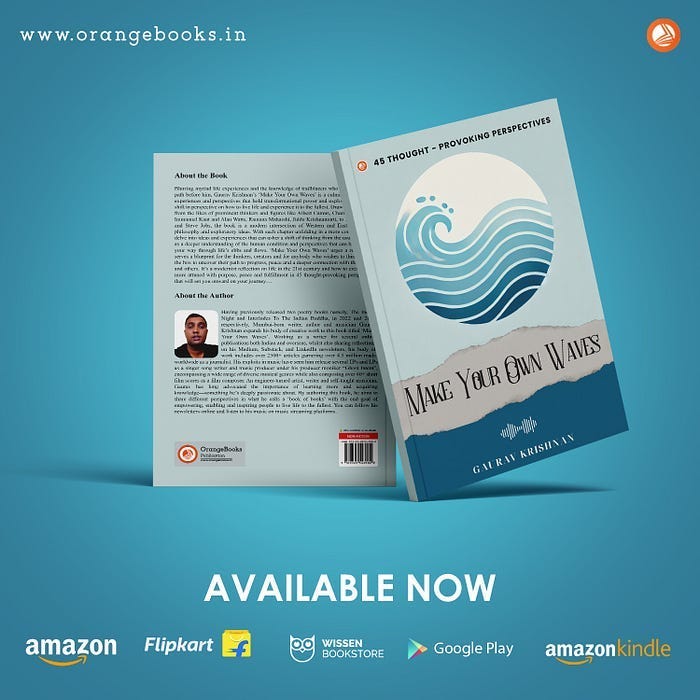
Life isn’t some game where becoming a billionaire or multi-millionaire is the ultimate goal and reward, and everything else doesn’t matter. Life is different for everybody, and the ways to live and what to strive towards vary from person to person. Of course, having enough money and a buffer in your bank account to live without financial stress is helpful. But people still live anyway. At the end of a lifespan, it really doesn’t matter whether you died a billionaire or you died not becoming one. What truly matters is how you lived from day to day and how freely you experienced life to its fullest. In the end, our graves stay the same. Schopenhauer saw human desire as an endless, restless will, a force that drives us forward, and the moment we satisfy one want, it manufactures another. What he suggested was a kind of resignation to that fact. An acknowledgement of the will through art, compassion, and the recognition that suffering is woven into the fabric of wanting. In his view, striving relentlessly was a kind of trap that we can’t get away from unless we eradicate our wants completely. Both Kierkegaard & Schopenhauer, separated by centuries, arrive at a similar place Minami would likely recognise, essentially that the problem is not where you end up. The problem is the belief that where you end up defines you. We spend so much of our lives performing for an imaginary jury, whether it’s our parents, peers, society, or some future version of ourselves who is finally, acceptably successful. We put so much pressure on ourselves and our lives to achieve, and that there is something to be ‘extracted’ from life, instead of just ‘living’ it. We delay contentment. We ignore rest & relaxation. We treat the present as immaterial and squander it for a life we’ll actually start living once things fall into place. Minami would tell you that things will not fall into place. And more importantly, they don’t need to. There’s something freeing & liberating about living like that. Life is short. And it will either end with you succeeding or failing, and that’s okay. The sooner we make peace with that, the lighter our lives become. So it’s better not to put so much weight and pressure on a lifespan, and to just live. Because, as ancient Greek philosophers suggested, at the end of a lifespan, “the richness of our days” matters more than any achievement or reward. It’s not what you did & what you achieved or your legacy or the corner office or the moment someone finally tells you that you made it. The richness of your days. That’s what matters most. The afternoon you laughed until your stomach hurt when your kids made you laugh by saying something funny. The time you danced to your favourite song with your loved one. The conversation you had with someone which had a profound impact on you. The morning you woke up early, went for a run, and the endorphins kicked in, making you feel really good. That piece of music or a film that moved you. That family trip where you set up camp by a lake with mountains in view, that made you feel totally in tune with nature and your loved ones. These are not bits and pieces of your real life. They are very much an integral part of your life. Minami’s book doesn’t ask you to stop trying. He says you can try and strive to achieve, but he warns against the futility of chasing, and offers solace that it’s okay even if you don’t get there eventually. He also asks you to stop tying your worth to outcomes you can’t fully control or to bank balances or the way society views you. Kierkegaard, meanwhile, suggests living authentically, something Albert Camus also advocated in his answer to facing “the absurd”. Schopenhauer, meanwhile, suggests stopping being enslaved by wanting. And the ancient Greeks simply asked, “Did you live well today?” That question is enough to base your life upon. And in this constant struggle and pressure to achieve, it might be the most important question you can ask yourself. So essentially, just breathe and relax. Stop putting so much pressure on yourself and your life, and live. It’s okay if you succeed or if you don’t. If you liked this article & it helped you in some way, you can buy my book Make Your Own Waves, which comprises 45 thought-provoking perspectives on life, which you can buy at the link: https://amzn.eu/d/dZaX8Dr If you’re in the US, you can buy it on Barnes & Noble: https://www.barnesandnoble.com/w/make-your-own-waves-gaurav-krishnan-krishnan/1147724812 If you’re in India, you can buy it here: https://amzn.in/d/fA4iDgb
Thank you for being a valuable subscriber to my newsletter Light Years! If you liked this post & found it informative, feel free to share this publication with your network by clicking the button below… I hope you found this post informative & it helped you in some way. As always, feel free to subscribe to my publication Light Years & support it & also share it if you’d like. Get it in your inbox by filling up the space below! You can find me on Medium on my Medium profile covering a plethora of topics (there’s a bit of difference between the posts here & there): https://medium.com/@gaurav_krishnan You're currently a free subscriber to Light Years by Gaurav Krishnan. For the full experience, upgrade your subscription.
|





No comments:
Post a Comment