
The “Full-Time Job” Is DyingThe full-time job dying: exploring how AI, the gig economy & digital platforms are reshaping work, shifting from fixed jobs to flexible, ownership-driven careers
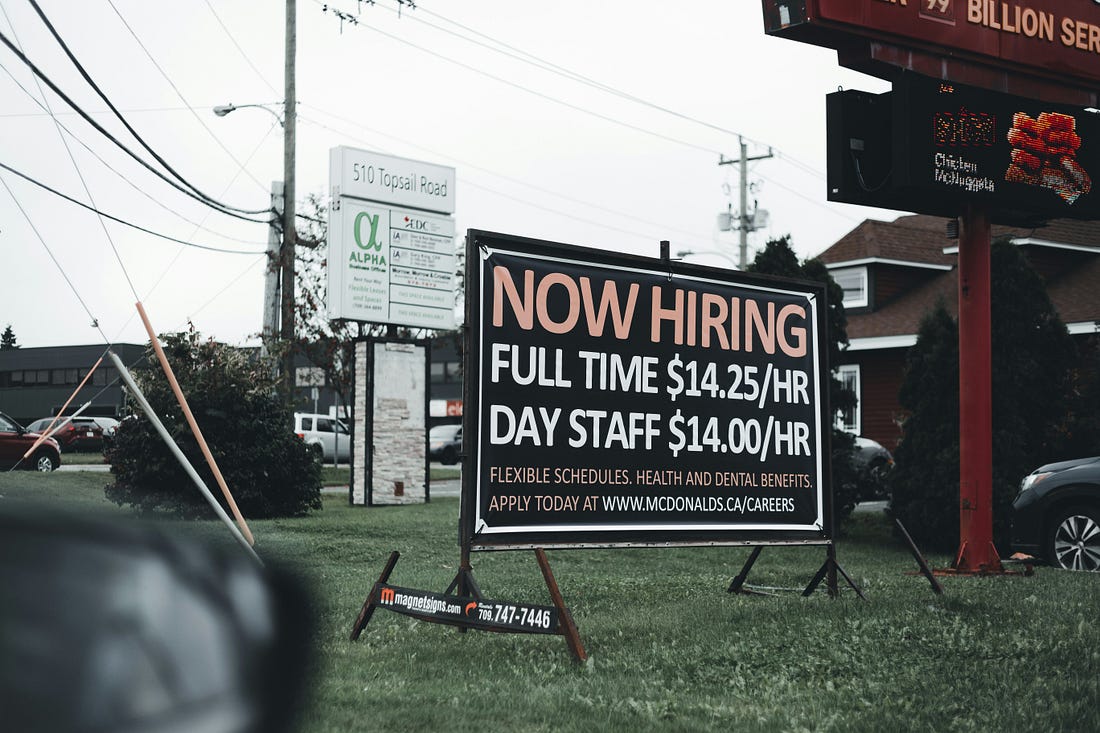
I recently posted about this on LinkedIn, aiming to convert it into a full-fledged article piece, so here it is. The idea of the “full-time job” is starting to feel outdated & is slowly dying. In fact, it could be replaced entirely in the future. As far-fetched as that sounds, the traditional “job” could entirely disappear in the coming decades. Let’s be honest, people only work “jobs” out of compulsion. Nobody is excited to build some founder’s or a team of founders’ dreams. They work because they have to. For their bills, rent, food, and survival. Not because they grew up thinking, “I can’t wait to help scale someone else’s company.” Since the dawn of the industrial revolution & the emergence of capitalism & for decades since, it was essentially simple: You trade your time for stability. One company. One paycheck. A singular, narrow job role & a predictable life. It worked because back then, people didn’t have many options. The information asymmetry gap & gap in availability of capital was enormous. The people at the top knew things you didn’t. The networks were closed. The barriers to entry were high. So you stayed in your lane, did your job, and hoped for a decent appraisal at the end of the year. If you lacked capital, connections, or access, or some key industry insights & tricks of the trade, you stayed where you were doing a job because there was nowhere else to go. That entire structure is being dismantled in today’s fast-paced times. Those constraints have now evaporated into digital ether, with first the coming of the internet & now AI. We’ve now got easy & streamlined access to knowledge, technology & capital. What we’re witnessing now is deemed as just a shift in how people work. But in truth, it’s a structural rewiring of the labour market itself. The old model was clean and predictable, i.e. employer, employee, fixed hours, defined role, monthly salary. What’s replacing it is far more fluid, and frankly, far more interesting. We’ve moved from sole proprietors (that was the norm for decades), to small teams of founders (called startups), to something far more fluid: Imagine this, a team of 20 freelancers all owning a chunk of equity, floating a digital enterprise where they all get a slice of the pie. Then there’s also the Solopreneur running an entire company alone, using AI tools from product, marketing, content, to operations, all powered by AI tools and automation that didn’t exist five or six years ago. You can see it everywhere. People are crossing projects and industries rather than staying glued to one narrow job role for decades. You could say that it’s simply moving from employees to freelancers. But it’s far beyond that at this stage. We’re moving from employees to participants. People are moving across projects. Owning outcomes. Choosing leverage over loyalty. Even Reid Hoffman (co-founder of LinkedIn) has spoken out about this, suggesting that the 9-to-5 isn’t some permanent structure, and that it’s dying. He suggests that it was a model that made sense for an industrial economy, but not for a networked one. What we’re witnessing is a complete shift in how people work, and it’s a systemic rewiring of the labour market, perhaps for good. Economists have long used the term monopsony to describe markets where a single buyer, in this case, an employer, has outsized power over workers because there are few alternatives. For decades, the traditional job market functioned a lot like this. Employers held the leverage. Workers showed up, negotiated from a position of weakness, and largely accepted the terms. That power dynamic is flipping. In the modern economy, output matters more than hours and “ownership” matters more than tenure. We’re shifting from “salary” to “equity”. From “working for” to “working with”. From “fixed hours” to “on-demand”. So what’s actually replacing the 9-to-5? The honest answer is: it’s still being figured out. We’re at an early, messy, transitional stage. What’s clear is that the old deal, i.e. your time in exchange for stability, is losing its appeal on both sides. Companies increasingly prefer variable cost structures over fixed headcount. Workers increasingly want control, flexibility, and a stake in what they’re building. The economic incentives on both sides are pushing away from the traditional employment model and toward something more fluid. What that looks like in practice is already visible: micro-entrepreneurship, fractional, freelance & gig work, project-based equity models, creator economies, AI-augmented solopreneurs running seven-figure operations. These first seemed like niche experiments. But now, they’re increasingly early indicators of a labour market equilibrium that’s shifting under our feet. You can already see it playing out everywhere. Platforms like Fiverr and Upwork turned skills into on-demand marketplaces. Uber and Zomato turned time into on-demand labour, selling your driving skills for a hybrid kind of self-employment. Instagram, YouTube, and X have produced an entirely new class of people who’ve essentially built micro-media businesses around themselves, all generating income through attention, creativity, popularity and audience. Yes, the algorithms determine their success, but it’s still a viable route of income centred around ownership. These seemed initially like anomalies, as fading fads, especially as the platforms and services were being adopted early on. But now they’re early signals of a much larger structural shift. People don’t want bosses & to stay at one company pigeonholed in one role. They increasingly want control. Flexibility of work. And a slice of the pie & ownership. People have already started owning their time & working on-demand. The aforementioned platforms & people adopting work through them reinforce that narrative. Economists sometimes call this the platform economy, and it’s steadily replacing the traditional employment model. These platforms aren’t just new ways to earn; increasingly, they’re early prototypes of a different labour model. It’s a model characterised by:
And then there’s AI. As machines take over tasks like the repetitive, predictable, routine, and mundane tasks that make up a surprisingly large chunk of most job descriptions, the balance shifts entirely to what can’t be automated. Judgment. Taste. Creativity. Perspective. Aesthetic taste. Original thinking. Contextual decision-making. The things that are irreducibly human. Where human input, human creativity, and human ingenuity matter far more than repeatable tasks that can be automated by AI. Research from McKinsey suggests generative AI could automate up to 30% of tasks across the global workforce by 2030. That doesn’t mean 30% of people lose jobs overnight, but it does mean the marginal value of routine labour is headed in one direction, and it isn’t up. We’re at an early version of a world where people choose when, how, and why they work. It’s where the labour-capital equation is being renegotiated, and increasingly fast, by millions of individuals around the world who have decided that the old deal was not good enough, and in many ways, the conventional “full-time job” is fading away. The full-time job will die eventually. And the idea, based on the assumption that this is simply how work and making a living works, is what’s totally coming undone. As technology, knowledge, and capital become easier to access than at any point in human history, only two things will matter: Your time. And your creativity. And those aren’t things people will give away easily & “full time.” If you liked this article & it helped you in some way, you can buy my book Make Your Own Waves, which comprises 45 thought-provoking perspectives on life, which you can buy at the link: https://amzn.eu/d/dZaX8Dr If you’re in the US, you can buy it on Barnes & Noble: https://www.barnesandnoble.com/w/make-your-own-waves-gaurav-krishnan-krishnan/1147724812 If you’re in India, you can buy it here: https://amzn.in/d/fA4iDgb
Thank you for being a valuable subscriber to my newsletter Light Years! If you liked this post & found it informative, feel free to share this publication with your network by clicking the button below… I hope you found this post informative & it helped you in some way. As always, feel free to subscribe to my publication Light Years & support it & also share it if you’d like. Get it in your inbox by filling up the space below! You can find me on Medium on my Medium profile covering a plethora of topics (there’s a bit of difference between the posts here & there): https://medium.com/@gaurav_krishnan You're currently a free subscriber to Light Years by Gaurav Krishnan. For the full experience, upgrade your subscription.
|





No comments:
Post a Comment