The Next Great Economic Shift Is ComingAn economic delve into how AI is reshaping labour, capital & ownership in the global economy, and why the next decade may determine who captures the most gains
 There’s been a lot said about AI online; it’s quite literally in every third post on whichever social media platform you’re on. But in this article, based on my research & some deep dives, I wanted to study the economic implications of AI and how it will shape our economic future. Every major technological shift in history has created two groups of people: those who understood it early and benefited, and those who only adapted once it became mainstream. Artificial intelligence may be the fastest such shift we’ve ever seen. This might sound slightly like doomsaying, but the next five to ten years could become one of the most important & significant income-generating windows of our generation. This window could prove pivotal because of the stage we’re currently in with AI development and adoption. On the surface, it does sound a little ludicrous. Economic shifts come and go, industries rise and fall, and new opportunities usually replace the old ones. Economists often describe this process as creative destruction, where innovation disrupts existing industries while creating new ones. Technologies like electricity, computing, and the internet are often classified as general-purpose technologies (GPTs) because they reshape entire economic systems rather than a single sector. So given my penchant for calling out doomsaying online, I thought the same thing. But then I started digging into the research. (During that process, I came across a related piece that explores similar ideas, drawing on commentary from figures like Elon Musk, Bill Gates & others while briefly examining the economic implications of AI.) The economy isn’t collapsing on itself, but the structure of wealth creation is changing rapidly. Artificial intelligence’s claws aren’t simply sinking into and altering the job market; AI is reshaping how value is produced & who captures it. And it’s moving fast (faster than any 30-minute Domino’s pizza guarantee).
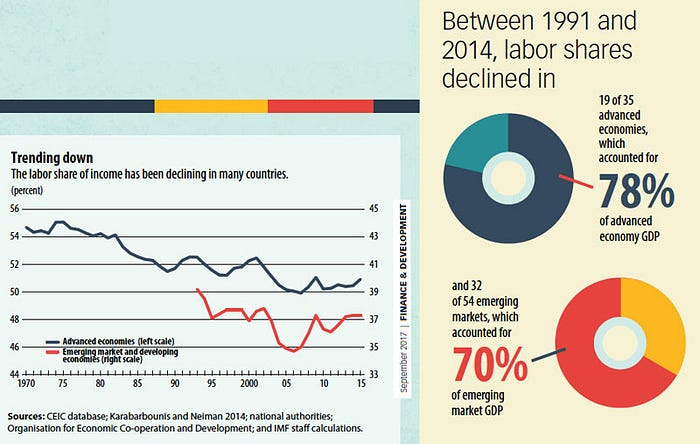
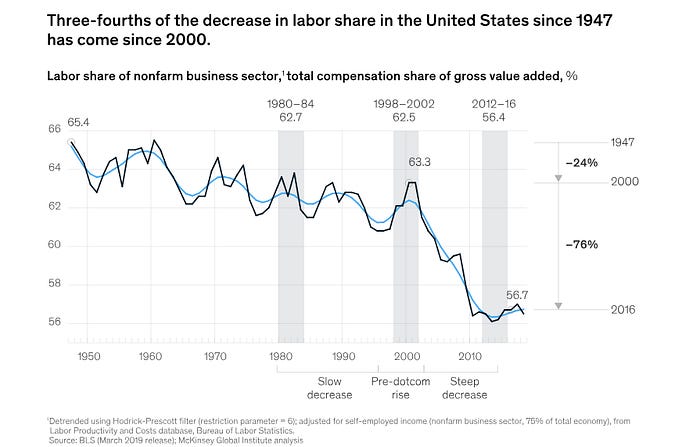
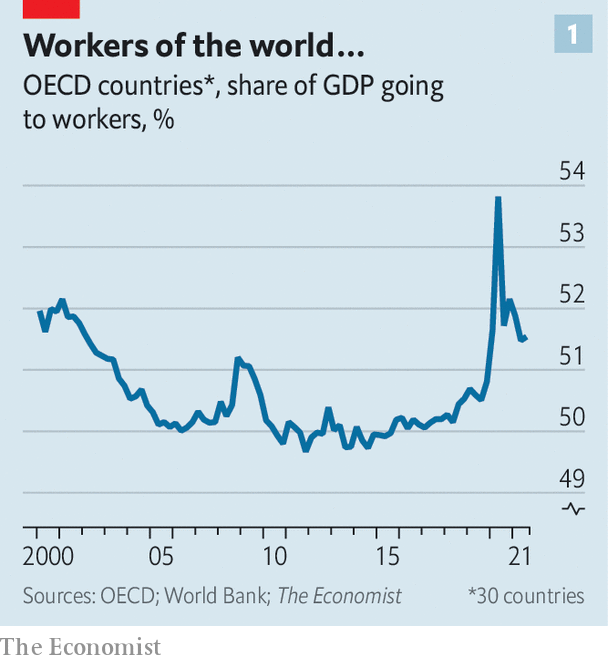
For the first time in modern economic history, small teams, or even individuals (like solopreneurs), can produce output that once required entire departments of organisations. Research from McKinsey suggests that generative AI could automate up to 30% of tasks across the global workforce by 2030, while Goldman Sachs estimates 300 million full-time jobs worldwide could be exposed to automation in the coming decade. That doesn’t necessarily mean all those jobs will disappear; some jobs will be axed while others will remain or spring up. However, what this does entail is that the traditional path to financial stability, i.e. education, employment, promotion, investing, and buying real estate, may become far more difficult to access. Not only are they going to become more difficult to access, but they’re also going to become more expensive than ever before. The emerging economic structure increasingly rewards asset ownership rather than wage income. And these next 5 to 10 years will determine who gets ahead and who gets priced out or economically left behind. The current economic narrative behind artificial intelligence may portray the highly publicised job losses, and everyone is losing their sh*t about that. But in the end, the emerging economic story hinges on who captures the productivity AI gains & enables. When Productivity No Longer Guarantees ProsperityEconomists have long debated what happens when technology dramatically reduces the need for human labour. In an AI-driven economy, the key source of wealth may no longer be work, but ownership. Imagine a world where software performs tasks once done by accountants, analysts, lawyers, or even doctors and does so faster and at near-zero marginal cost. Then there’s robotics to come as well. The traditional path of getting a college education, getting a job, and buying a house is becoming more expensive and cumbersome to achieve compared to the advantages that AI gives to capital and top-bracket individuals leveraging AI. AI doesn’t merely replace work & jobs; it magnifies the productivity of those who control capital and technology. In other words, AI acts as leverage. But for people who own assets in the form of businesses, intellectual property, equity, or digital platforms, AI multiplies their output. However, for those who rely solely on wages, AI becomes competition. This is essential to understand. Subsequently, this creates a fundamental shift where working harder in a job role no longer guarantees getting ahead. Furthermore (as I’ll explain later on), the labour share of income has been periodically declining in most countries, even more so in emerging markets.
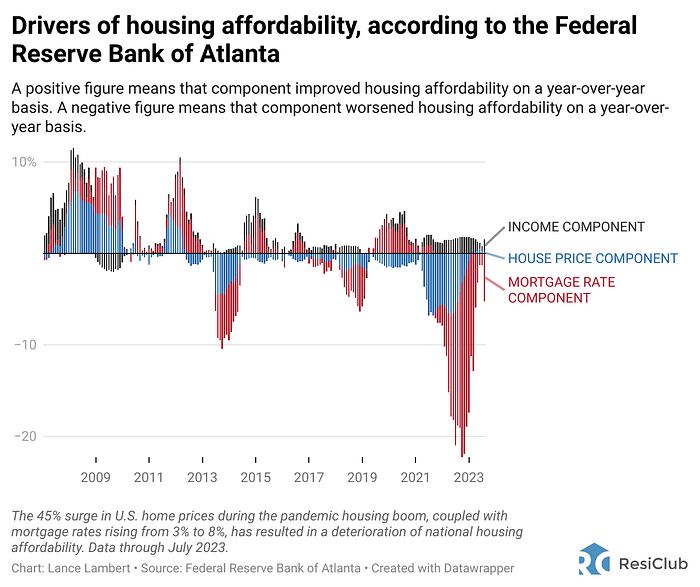
Some Economic Trends Already Taking ShapeSeveral forces are quietly reshaping the economic landscape, prompted (pun intended) by AI adoption. 1. The Rise of Winner-Take-Most Labour MarketsTechnological revolutions have always concentrated rewards among top performers, but artificial intelligence may accelerate this dynamic dramatically. In economic terms, AI is increasing returns to skill and productivity, allowing a single highly skilled worker to generate the output that previously required entire teams. A programmer equipped with advanced AI tools can write code faster, analyse data quicker, and deploy products at a fraction of the previous cost. Some AI researchers estimate that up to 40–50% of entry-level white-collar roles could be affected by automation within the next decade, particularly in fields such as administration, customer support, and analytics. The result could resemble a “K-shaped economy”, wherein individuals who own assets or possess highly leveraged skills experience rising incomes while wage-dependent workers face stagnation or decline. 2. Capital Market PrivatisationAnother major structural shift is occurring in global capital markets. Over the past three decades, the number of publicly traded companies in the United States has fallen from over 7,000 in the late 1990s to roughly 4,000 today. At the same time, trillions of dollars have moved into private equity, venture capital, and late-stage private funding rounds. This means much of the explosive value creation now occurs before companies reach public markets. By the time firms like technology giants eventually list on stock exchanges, they often already carry valuations exceeding $100 billion, leaving fewer opportunities for everyday investors to capture early growth. Economists increasingly describe this shift as the privatisation of economic upside. 3. The Human Capital Productivity DivideAI is creating a widening divide between workers who use technology effectively and those who do not. Studies from consulting firms suggest employees who integrate AI tools into their workflow can increase productivity 2x to 5x, depending on the task. In labour economics, this reflects a widening human capital productivity gap. Workers who learn to complement automation become more valuable, while those performing easily replicable tasks face greater substitution risk. Much like computer literacy in the early 2000s, AI literacy may soon become a baseline economic requirement. 4. Housing Affordability CompressionHousing markets, which were historically one of the most reliable vehicles for middle-class wealth creation, are also undergoing structural pressure as well. According to the Federal Reserve, housing affordability in the United States reached its lowest level in decades in 2023, as median home prices surged nearly 40% since 2020, far outpacing wage growth. Similar affordability crises are emerging in major global cities where limited supply, institutional investors, and rising construction costs push home ownership further out of reach. Economists increasingly describe this trend as housing wealth stratification, where property ownership becomes concentrated among older generations & high-income households. This matters because housing has historically been the primary wealth-building mechanism for middle-class households globally.
5. Rising Returns to CapitalOver the past several decades, returns to capital have consistently outpaced returns to labour. This phenomenon, widely discussed in the work of economists like Thomas Piketty, reflects a broader trend where capital accumulation grows faster than wage income. Stock markets, real estate, and business equity have delivered substantial long-term returns, while median wage growth has remained comparatively modest. As AI boosts productivity and lowers operating costs, companies and asset owners may capture a larger share of economic output, further underpinning the importance of ownership.
6. The Declining Marginal Value of Routine LabourAutomation and AI disproportionately affect routine and repeatable tasks. Economists call this phenomenon routine-biased technological change. Jobs involving predictable processes such as data entry, bookkeeping, or basic administrative work are particularly vulnerable. By contrast, roles requiring creativity, complex judgment, or interpersonal interaction tend to remain more resilient. This shift may continue hollowing out the middle of the labour market, expanding both high-income knowledge roles & lower-income service positions.
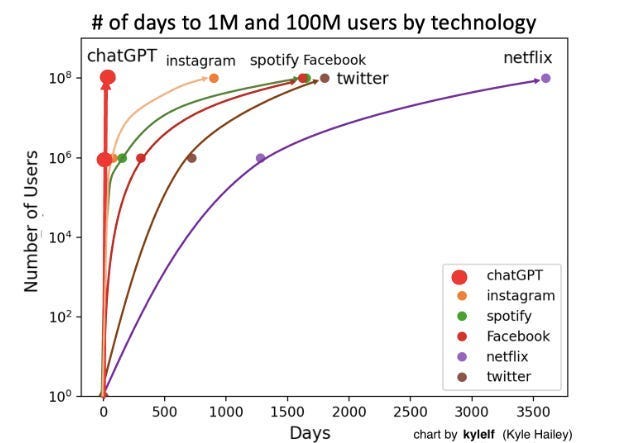
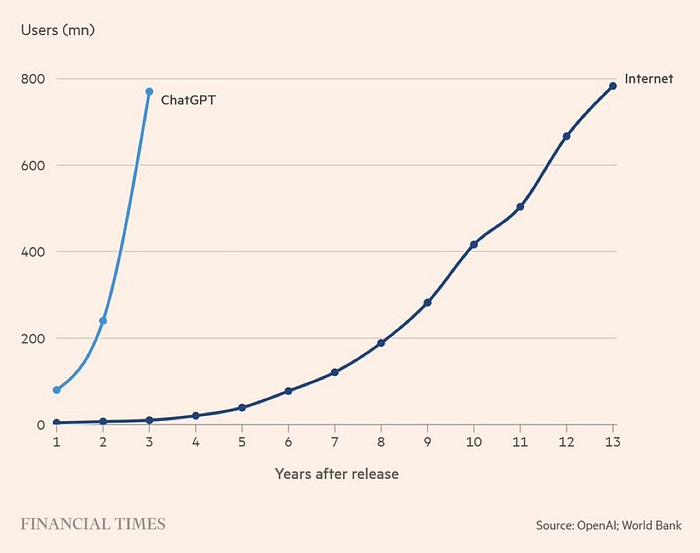
7. The Expansion of Digital Micro-EntrepreneurshipOne of the most overlooked consequences of AI and automation is the dramatic reduction in the cost of starting and operating a business. A single individual can now build websites, produce content, run advertising campaigns, analyse data, and automate operations with minimal capital & reduced effort. This trend is contributing to the rise of micro-entrepreneurship, where individuals create small but profitable businesses serving highly specialised markets. According to the Global Entrepreneurship Monitor, entrepreneurial activity worldwide has increased significantly since 2020, fueled in part by digital platforms & automation tools. 8. The Acceleration of Technological Adoption CyclesPerhaps the most striking feature of the current AI wave is the speed of its adoption. Historically, major technologies took decades to reach mass adoption. Electricity, automobiles, and personal computers all spread gradually across industries. Artificial intelligence, however, is spreading far faster. Tools like generative AI reached over 100 million users within months, making them among the fastest-adopted technologies in history. From an economic perspective, faster adoption cycles mean shorter windows for early-mover advantages. Those who adapt early may capture disproportionate benefits before the technology becomes standardised across industries.
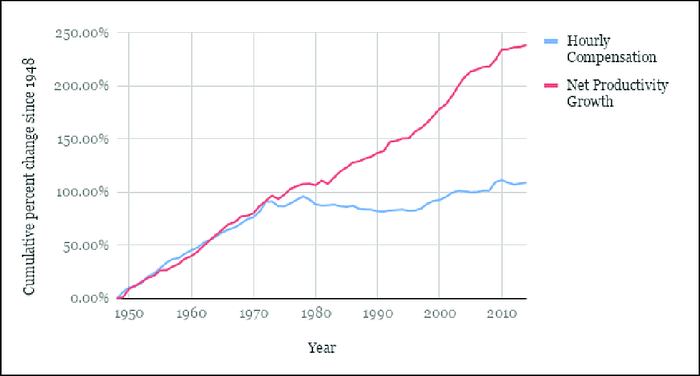
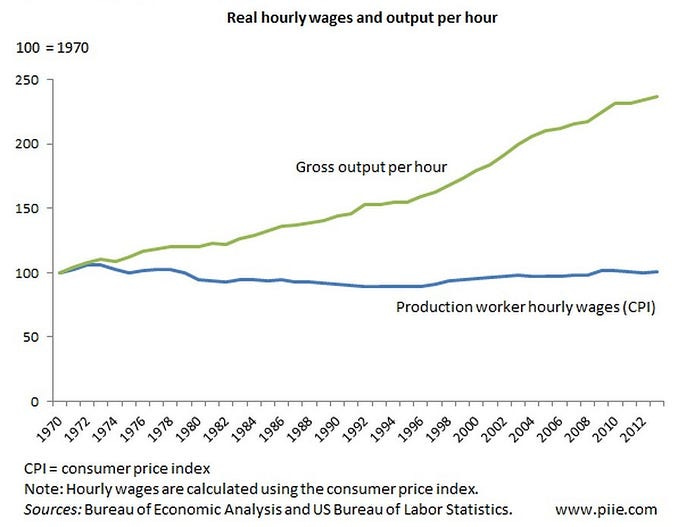
The Economics of The Great DecouplingThere’s an economic term called “The Great Decoupling” which is also at play here. According to its definitions, “The Great Decoupling” refers primarily to the widening gap since the 1980s between rising labour productivity and stagnant median wages/employment. Driven by technology and globalisation: output grows, but gains accrue to owners of capital rather than workers. So then this shift is not entirely new. Since the 1980s, productivity and wages have moved in different directions. In the United States, worker productivity increased roughly 80% since 1979, while typical hourly compensation rose only about 30% over the same period. The majority of gains flowed toward corporate profits, shareholders, and executive compensation.
Labour productivity has risen sharply since the late 1970s while median wages have grown far more slowly, a phenomenon economists often call “The Great Decoupling.” AI could accelerate “the great decoupling” by reducing the demand for labour even further. But paradoxically, it also lowers the barrier to entry for entrepreneurship. A single individual equipped with AI tools can now build software products, run marketing campaigns, analyse data, and operate businesses that once required entire teams. The AI Golden Generation (Not Like England’s International Football Team From 2006)Despite fears of job losses, history suggests technological revolutions tend to create more opportunities than they destroy. During the early 20th century, agriculture dominated the labour market in the United States, employing close to a third of the workforce. Advances in mechanisation, fertilisers, and industrial equipment dramatically reduced the demand for farm labour. Yet rather than triggering permanent unemployment, the shift increased overall productivity and allowed labour to migrate into expanding sectors such as manufacturing, transportation, retail, and eventually the modern service economy. AI may follow a similar path. The real question isn’t whether new opportunities will appear, but who captures the economic upside. So here’s what you can do about this, in the coming years. The Strategy for the Next DecadeIn an AI-accelerated economy, a few principles become increasingly important. 1. Invest in Productivity-Enhancing Human CapitalEconomic growth has always been driven by improvements in human capital. As automation spreads, the value of workers who can complement technology rather than compete with it will rise. The OECD estimates that AI could affect roughly 27% of jobs across advanced economies, meaning workers who understand how to operate alongside these tools will capture disproportionate gains in productivity and wages. In economic terms, the goal is simple: increase the marginal productivity of your labour. 2. Build Exposure to Multiple Income-Producing AssetsModern economies increasingly reward individuals who generate income from multiple sources of capital, not just wages. According to the U.S. Federal Reserve, the top 10% of households derive nearly half their income from investments and business ownership, while the majority of households rely primarily on wages. Developing exposure to multiple income streams, whether through digital businesses, digital assets, intellectual property, or investments, reduces dependence on a single labour market. 3. Accumulate Productive AssetsThroughout economic history, the largest wealth gains have flowed to those who own productive assets, rather than those who rely solely on wages. Whether during the Industrial Revolution, the expansion of the stock market, or the rise of the internet economy, the pattern has remained remarkably consistent: those who control capital tend to capture the majority of productivity gains. In the modern economy, productive assets increasingly include:
As artificial intelligence increases productivity and lowers the cost of production, the economic returns flowing to capital, particularly scalable digital assets, may grow even faster than returns to labour. As technology increases output, returns to capital tend to rise faster than returns to labour. And in an AI-driven economy, owning a piece of the system may matter far more than simply working within it. 4. Strengthen Balance Sheet StabilityPeriods of technological disruption often coincide with economic volatility. Maintaining a strong personal balance sheet in the form of low leverage, liquidity reserves, and diversified assets creates resilience during market shocks & dips. As an example, during the 2008 global financial crisis, households with lower debt burdens recovered significantly faster than those with high leverage. From an economic standpoint, the objective is simple: maximise optionality while minimising fragility. 5. Position Yourself in High-Growth Economic SectorsTechnological revolutions consistently create new clusters of economic growth. Over the past century, capital and labour have shifted toward sectors such as electricity, automobiles, computing, and the internet. Today, similar shifts are occurring in:
Historically, individuals who position themselves within expanding sectors capture significantly higher income and investment opportunities than those in stagnant industries. A Case For The ArtsGiven my industry of music and journalism/writing, I had to touch upon the economic implications of AI in art. So if you’re already into the arts or are mulling over embarking on a career in the arts, this is where this section could give you some insight. From an economic perspective, creativity occupies a different category of labour than routine knowledge work. Much of what AI automates falls under routine or semi-routine cognitive tasks, i.e. processes that follow repeatable patterns. Artistic creation, however, tends to operate in markets driven by scarcity, authenticity, and cultural signalling, where the value of the work is tied to the human behind it. Economists sometimes refer to this as superstar economics. In creative industries such as music, film, literature, and design, a small number of creators capture a disproportionate share of attention and income because audiences value originality and identity, not just output. However, the middle tier of artists may experience a more complex shift. Independent musicians, designers, filmmakers, and writers who already operate outside major institutions could use AI as a productivity tool and multiplier, lowering production costs, speeding up workflows, and allowing small teams or even individuals to compete with larger studios. In other words, AI may squeeze the lowest tier of commoditised work while simultaneously empowering the professional middle tier that combines human creativity with technological leverage. AI can generate content, but it cannot replicate the cultural capital, narrative, and reputation that give creative work economic value. What AI is more likely to do is compress the lower end of the market. Stock music, basic graphic design, templated writing, and other commoditised creative tasks may face price pressure as supply increases dramatically. In economic terms, AI expands the supply curve of generic content, pushing down prices for work that lacks differentiation. But at the higher end of the market, the opposite may occur. As the volume of AI-generated content floods digital platforms, human-made work becomes a scarce signal, and scarcity tends to increase value. The result is not necessarily the disappearance of artists, but a barbell effect, i.e. where routine creative labour becomes automated while distinctive, human-driven work becomes more valuable. In this sense, AI functions less as a replacement for creativity and more as a productivity multiplier. It lowers the cost of production, accelerates experimentation, and allows artists to operate with the scale of small studios. The economic outcome is likely to resemble previous technological shifts in the arts, where new tools expand the creative frontier rather than eliminate the creator itself. Opportunity Still Exists, But the Window Is NarrowAI will likely increase productivity and lower the cost of producing many goods and services as we head into the future. Some futurists even argue we may eventually move toward an “abundance economy” where technology dramatically reduces scarcity. But in the transition period, wealth may concentrate among those who adopt AI tools early. The next five to ten years may therefore represent something unusual in economic history: a brief window where individuals can leverage powerful technologies before they become universally adopted. In that sense, the next five to ten years could prove pivotal to those who leverage AI to own, build, rent & sell, compared to those who simply rely on wages. Those who do so will have a head start, while others could risk being priced out or economically marginalised. Every major technological revolution redistributes opportunity. It happened with electricity. It happened with the coming of computers. It happened with the internet. Artificial intelligence will do it again. The real implication of AI’s economic shift isn’t about job losses or whether the economy will change. It’s whether you’ll be positioned on the side that benefits from it. If you liked this article & it helped you in some way, you can buy my book Make Your Own Waves, which comprises 45 thought-provoking perspectives on life, which you can buy at the link: https://amzn.eu/d/dZaX8Dr If you’re in the US, you can buy it on Barnes & Noble: https://www.barnesandnoble.com/w/make-your-own-waves-gaurav-krishnan-krishnan/1147724812 If you’re in India, you can buy it here: https://amzn.in/d/fA4iDgb
Thank you for being a valuable subscriber to my newsletter Light Years! If you liked this post & found it informative, feel free to share this publication with your network by clicking the button below… I hope you found this post informative & it helped you in some way. As always, feel free to subscribe to my publication Light Years & support it & also share it if you’d like. Get it in your inbox by filling up the space below! You can find me on Medium on my Medium profile covering a plethora of topics (there’s a bit of difference between the posts here & there): https://medium.com/@gaurav_krishnan You're currently a free subscriber to Light Years by Gaurav Krishnan. For the full experience, upgrade your subscription.
|
Saturday, 28 March 2026
The Next Great Economic Shift Is Coming






Subscribe to:
Post Comments (Atom)


No comments:
Post a Comment