Laplace’s Demon & The Simulation Argument— Exploring Reality, Prediction, & the Limits of KnowledgeConnecting the theories of Laplace’s Demon & Nick Bostrom’s Simulation Argument as possible answers to the nature of reality
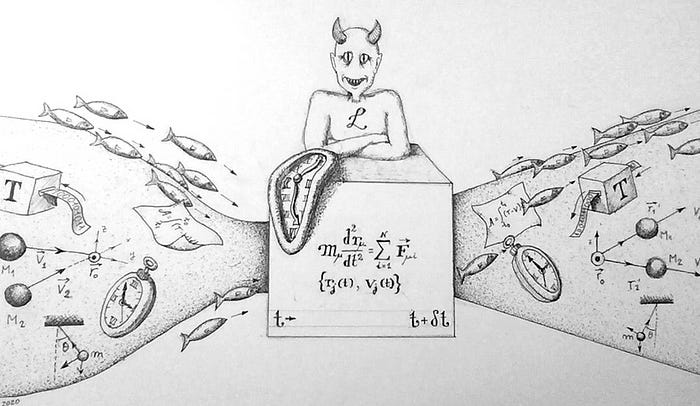
To look up & ask the big questions is ingrained in our very being. We as human beings, have contemplated the nature of existence since time immemorial. Ever since humans had the ability to think, we’ve pondered on the nature of existence & reality. In that context, the two thought experiments I’ll be presenting in this article challenge our understanding, examining the universe from their perspectives & viewpoints. They’re yet another pair of theories offering an explanation of how the very fabric of reality could be constructed. These ideas rest on scientific determinism, a concept suggesting every universal action is bound by causal laws, shaping not only the stars & planets but also our very existence. Scientific Determinism: The Foundations of PredictabilityScientific determinism rests on the idea that everything that happens in the universe, from the motion of planets & stars, to microscopic phenomena, are governed by cause and effect. From the moment of the Big Bang, if we knew every particle’s position, speed, and every possible influence, we could theoretically map out every past and future moment. The roots of the philosophy of determinism largely originate from Newtonian physics. They were born out of a period when the universe seemed to follow predictable laws. Newton’s principles showed that the motion of objects from objects on Earth to the planetary bodies in the cosmos could be calculated to precise degrees, creating a sense that, given enough data, the future might be predictable. However, while Newton’s ideas provide a comforting view of a predictable, clockwork universe, governed by a set of parameters & laws, modern physics, especially quantum mechanics, challenges this by introducing uncertainty. Quantum mechanics holds that particles can exist in multiple states (wave or particle) until observed, implying a fundamental randomness at the core of matter. Furthermore, according to the Heisenberg Uncertainty Principle, certain properties of particles, like position and momentum, cannot both be measured exactly at the same time. This has led to a stark rethink of causality and predictability, as events at the quantum level can appear random and indeterminate. However, despite this, interpretations like Bohmian mechanics still strive to fit quantum mechanics within a deterministic framework, suggesting that indeterminacy may be more about our knowledge limits than true randomness. But coming back, in a deterministic universe, then, if we knew all possible variables, we could theoretically predict every event. This is where Laplace’s Demon comes in. Laplace’s DemonPierre-Simon Laplace, an 18th-century French mathematician & scholar, proposed a radical thought experiment to explore this deterministic view of the universe. He imagined a being, now famously called Laplace’s Demon, with such vast intelligence & computing power that it knows the exact position and momentum of every particle & object in the universe. With this knowledge, he argued, the demon could calculate every event that has ever occurred or will ever occur. If the universe is indeed deterministic, this demon could foresee every outcome. Laplace’s concept renders a fully ordered and predictable universe, where uncertainty is eliminated, and every future moment unfolds as a calculable result of prior conditions. But the major challenges to Laplace’s Demon come from quantum mechanics. Heisenberg’s uncertainty principle implies that it’s impossible to know both the position and momentum of a particle precisely, suggesting fundamental randomness. For Laplace’s Demon, this inherent uncertainty means it could never attain the perfect information it needs to predict everything. Even in a deterministic framework, chaos theory, which explains chaotic systems (like weather patterns, the stock market, or any other chaotic system) are so sensitive to initial conditions that small variations lead to vastly different outcomes. So even if we theoretically could know all initial conditions, chaotic systems add a layer of unpredictability that challenges the demon’s power. For Laplace’s Demon to work, the universe would need to be as predictable as a mathematical equation. Yet, as we dive deeper into quantum mechanics and chaos theory, it becomes evident that knowledge has limits. Therefore, the demon’s perfect knowledge becomes more of a conceptual argument than an achievable reality. Now, let’s explore the Simulation Argument put forth by Nick Bostrom. The Simulation Argument: Are We Living in a Programmed Reality?If Laplace’s Demon represents the idea of an entity with perfect knowledge, the Simulation Argument explores the concept of a world perfectly controlled by external intelligence. Proposed by philosopher Nick Bostrom, the Simulation Argument puts forth the theory that it’s plausible we are living within a computer simulation designed by an advanced civilization. If such simulations can be created and are widespread, then the likelihood that our reality is “real” is minimal compared to the possibility that it’s an artificial construct. In an earlier article, I explored the Fermi Paradox which was proposed by Nobel Prize winning scientist Enrico Fermi which suggests that given the universe is 13.7 billion years old & the solar system is just 4.5 billion years old, given a 9.2 billion year headstart, there could be life out there in the universe with highly advanced technology & superhuman computing power. Given that argument & relating it to Bostrom’s Simulation Argument, the likelihood that alien life could have such advanced technology that they’ve programmed our reality or have constructed an ancestral simulation is perhaps likely. As explored on the dedicated website on The Simulation Argument:
The Simulation Argument rests on three propositions called Bostrom’s Trilemma:
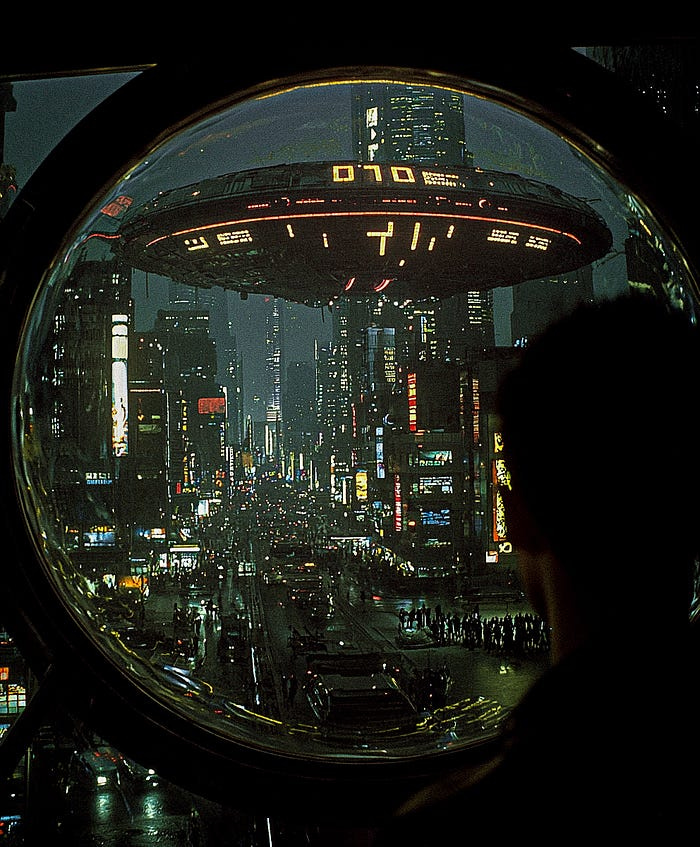
If the third proposition holds true, we might be living in a universe built by external intelligence, governed by rules set by their programmers. This reality could appear just as structured as a natural world, but is ultimately governed by a pre-defined “code.” Some researchers have speculated that certain quantum phenomena, like wave-particle duality and space-time granularity, could be consistent with digital “code.” Others argue that such phenomena simply reflect the underlying physics of the natural universe, with no artificiality implied. As we slowly venture into the world of quantum computing, perhaps our understanding of quantum physics could also expand considerably. But considering the amount of technological progress & the kind of tech we have today, it’s a compelling argument to suggest that our future selves, millions of years ahead, could have the computing power to run an ancestral simulation & perhaps we’re in what is just one simulation amongst a vast sea of others. Counterarguments To Both Theories
In recent years, science and philosophy have offered nuanced views on the limits of predictability & the counterarguments to both theories: With randomness intrinsic to quantum mechanics, it’s increasingly accepted that perfect knowledge of the universe’s future states is impossible. Furthermore, even if advanced civilizations have the technology, the massive computational power needed to simulate an entire universe with conscious beings presents logistical challenges. Consciousness, meanwhile, remains yet another profound mystery: “the hard problem” as it’s called. Some argue that a simulated reality might not be able to create self-aware beings, meaning that if we are conscious, we might exist in an authentically real universe rather than a programmed one. Determinism In Today’s TimesToday, determinism is often seen through a more nuanced lens. Instead of a rigid, clockwork universe, we view reality as a complex interplay of deterministic processes and probabilistic events. In many fields, from biology to weather forecasting, determinism is understood as an approximation that works well at large scales but has limits when it comes to microscopic, quantum or highly sensitive systems. Our modern view balances the deterministic structure of classical physics with the randomness of quantum mechanics and the sensitivity of chaotic systems. This more complex understanding invites us to consider that the universe might not be entirely deterministic or fully random, but rather a blend of both, i.e. organised in ways we are still discovering. Correlating Laplace’s Demon and the Simulation ArgumentBoth Laplace’s Demon and the Simulation Argument explore the idea that our reality could be fabricated. Both thought experiments, which are centuries apart, suggest that our reality isn’t what it seems & isn’t the “ultimate real reality”. As per Laplace’s theory, the demon could, hypothetically, know every causal factor that occurs in the universe, suggesting our world could be simulated theoretically, while Bostrom’s argument suggests reality is an advanced computer program, created by beings outside our reality or maybe even our future selves. If our world is indeed a simulation, subsequently, our understanding would be limited by the constraints of the simulation itself. This would place boundaries on what knowledge we could obtain, similar to Laplace’s Demon’s theoretical limitations. In a deterministic universe, prediction is limited by quantum indeterminacy and chaos. In a simulated universe, knowledge is limited by what the programmers of the simulation allow us to perceive. Whether it’s the inability to know everything in a quantum universe or the constraints of simulated reality, both ideas reflect limitations on how much we truly know about our existence & the nature of our reality. Together, these ideas challenge our understanding to consider whether our universe is knowable in principle or limited by design. They further echo inquiries that shape the very essence of our existence, such as what is the true nature of reality & the universe? Perhaps we’ll know the answer someday in the far reaches of the future. This post was originally published on my Medium. Thank you for being a valuable subscriber to my newsletter Light Years! If you liked this post & found it informative, feel free to share this publication with your network by clicking the button below… I hope you found this post informative & it helped you in some way. As always, feel free to subscribe to my publication Light Years & support it & also share it if you’d like. Get it in your inbox by filling up the space below! You can find me on Medium on my Medium profile if you’re a Medium member covering a plethora of topics (there’s a bit of difference between the posts here & there): https://medium.com/@gaurav_krishnan If you’d like to thank me for this post, if you found value in it, you can buy me a coffee instead of, or alongside subscribing to my publications, by scanning the QR code below so that I can sip my next brew of coffee, all thanks to you! :)
You're currently a free subscriber to Light Years by Gaurav Krishnan. For the full experience, upgrade your subscription.
|
Saturday, 19 July 2025
Laplace’s Demon & The Simulation Argument— Exploring Reality, Prediction, & the Limits of Knowledge








Subscribe to:
Post Comments (Atom)


No comments:
Post a Comment