The title of this post is to indicate that we do NOT refer to the learned jurist Oliver Wendell Holmes JUNIOR (1841-1935) who served on the U.S. Supreme Court from 1902 to 1932, and was the 3rd most cited American legal scholar of the 20th Century, who upheld TR's expansion of Presidential powers in the creation of regulatory agencies, and who coined the bit about the First Amendment not protecting your right to yell "fire" in a crowded theatre. As I say, not that guy. Today we're going to promote awareness of his unjustly forgotten FATHER.
How rare is it that a guy named "Junior" eclipses an already eminent Old Man? Mighty rare, as I laid out in this previous post. Three words convey it: "Frank Sinatra, Jr". But I'm here to remind you that Oliver Wendell Holmes, Sr. (1809-1894) was an extremely important figure as well. The elder Holmes had been trained in the law, as well, but that was the least of his attributes and accomplishments. He was the man who named The Atlantic Monthly when it was founded in 1857. He was the man who saved the (still surviving) U.S.S. Constitution from being scrapped in 1830 with his poem "Old Ironsides". He coined the phrase "Boston Brahmin". Known as one of the Fireside Poets, his literary cohorts included Ralph Waldo Emerson, Henry Wadsworth Longfellow, and James Russell Lowell. He knew Washington Irving and Nathaniel Hawthorne. Yet while many considered him one of the greatest American authors of the 19th century, in the tradition of Rabelais and Smollett his primary day-in, day-out work was as a DOCTOR. He made several important contributions to the medical field that are outside my purview.
Holmes' most highly regarded literary work was his book The Autocrat of the Breakfast-Table (1858) and its sequels, The Professor at the Breakfast-Table (1860), The Poet at the Breakfast-Table (1872), and Over the Teacups (1891). The contents of these books had originally been generated for the pages of The Atlantic. I've read the first in the series, literally because it was on a list of great books and its title begins with the letter "A". The book is not a novel, but like all of America's greatest books, a sui generis. I had tried to tackle it a couple of times when I was younger but didn't get very far on those occasions, because though technically it's a narrative, it's presented as a series of conversations, and so there is a stream-of consciousness element to it. In other words, there's no plot per se; it's more like a series of essays.
The titular Autocrat is just a guy holding court at the breakfast table in his rooming house, inflicting his ideas on his fellow lodgers, the landlady, and her daughter. The rambling nature of the discourse reminds me of Tristram Shandy; the combination of humor and wisdom reminds me of Poor Richard's Almanack. Holmes' poetic sensibility (for the pieces have poems in them as well) remind me of Wordsworth. For some reason, I had carried around in my head an idea that the Autocrat was intended to be a foolish blowhard, but the experience turns out to be much richer and more complex than that. While he's definitely vain and smug and a conversation hog, he's also clever and philosophical and sometimes even poignant. He quotes Erasmus, Dr. Johnson, and Pope. There are passages in Latin and French. One gets the sense that it's a healthy self-parody. My jaw hit the floor when I was reading the poem "The Chambered Nautilus" and came across the phrase "More Stately Mansions". Eugene O'Neill used this as the title of one of his plays!
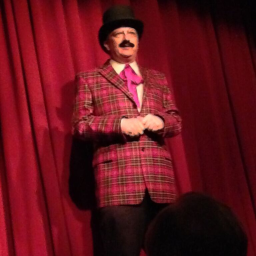
A tip that may help you enjoy the book despite its challenging nature is to think of it as a kind of proto-typical stand-up comedy or performance art in the Spalding Gray vein. Very much in a similar spirit. And Holmes did work the lecture circuit like all of his contemporaries. The photo above depicts a "caution"; I conjecture that he was hilarious on the stump.
As it happens, OWH Senior was not the first significant member of his family, either. I am very interested in his father, the Congregationalist (Puritan) Minister Abiel Holmes (1763-1837), who came from my mother's very small hometown of Woodstock, Connecticut and married the daughter of Yale President (and Brown co-founder) Ezra Stiles (1727-1795). Thus Stiles was the maternal grandfather of the elder Oliver Wendell Holmes, Sr. In his younger years Stiles had preached at the two principal congregations in Newport, my own backyard. And on his mother's side, Holmes was descended from Anne Bradstreet (1612-1672), America's first published poet.





No comments:
Post a Comment