Happy New Year! and April Fools!
I don't mean the opening salutation as an April Fool's Day joke. Maybe you'd better sit down for this, because it's the truth and not a prank, and it's completely disorienting. From ancient times until quite recently (the advent of the Gregorian calendar, in 1582), the "New Year" began at the Vernal Equinox, traditionally celebrated March 25, though we now know that particular solar moment happens on March 20. We have "January 1" so thorough ingrained in our heads now that it feels downright impossible (at least it does for me) to wrap your head around the fact that the names and the dates we assign to months and days are COMPLETELY ARBITRARY. Where we start a year can begin ANY day. So the old way used to be to put the New Year at Spring; nowadays we put it at (or near) the Winter Solstice.
I come to this topic because I have been investigating the Pagan/Christian holidays and their relationship to theatre. (Non-Christians, please excuse my use of the first person in the foregoing. I'm speaking of the West and Europe and the prevailing culture in those nations. If you have different holidays and a different calendar, this isn't to slight you, it's just less relevant to the topic at hand). Anyway I learned that the shift of three months of where we start the year is basically what made Christmas and Easter different holidays. (Christ's birthdate, which is unknown, was originally "chosen" to be the same as the date on which he died, or near it). Christmastide as you know, is basically a week of celebration culminating on New Year's Day. The date of Easter changes every year so that it will always fall on a Sunday, but basically if you celebrate a week beginning with the old idea of Vernal Equinox (March 25) you arrive at April 1. And I tell you all this because that is why April Fool's Day is a day to celebrate anything at all, let alone pranks. It's all kind of become unmoored and disassociated in modern times. But basically, we could and should loop together all of our spring holidays the way we do the winter ones, into a "season". Vernal Equinox, Good Friday, Easter, April Fool's Day and for that matter Earth Day and May Day, all kind of one stretch, all aspects of the same celebration. (We'll leave Tax Day well out of it).

Anyway, there used to be a thing called the Feast of Fools on January 1. The shift meant that it was moved to April 1: April Fool's Day. Many might assume it to be a frivolous 20th century invention, but its Pagan roots go back for millennia. It may have roots in the Roman festival of Saturnalia, for it shares with the theme of turning everything upside down. The specific phenomenon we're speaking of was celebrated in Europe (France in particular), roughly from the 1100s through the 1460s. I'm sure I first became aware of it by way of Victor Hugo's The Hunchback of Notre Dame, which had a major scene set against that backdrop, and/or Mikail Bakhtin's writings on Carnival and Rabelais. Like most folk phenomena, frustratingly little is known about the festival, only what can be gleaned from the occasional contemporary reference. . Basically the social order was flipped on its head for a couple of days in a kind of cathartic mock revolution. The lowly were treated as highborn, while the aristocracy and other leaders bestowed honors upon them and gave them license to run amok. (A similar atmosphere pervades that other Pagan survival, Halloween -- where young people have "permission" to run a little bit wild for one night committing minor acts of vandalism). Part of the Feast of Fools ritual involved electing someone from the bottom of the pecking order as the "Lord of Misrule", a mock Pope, King or Bishop -- this is what happened to Quasimodo in Hunchback.
What prevented the Feast of Fools from being considered a blasphemy for such a long time was that, in essence, it is an intensification of the entire message of Christianity, in which the Messiah is the humblest of men, a carpenter, born in a stable. It relates to the idea of the Holy Fool, the Christ-like innocent who is regarded by society as a buffoon, which Bakhtin wrote about in relation to Dostoyevsky's The Idiot. There is a place where comedy and foolishness can be considered wise. This idea always makes me think of the image of the Laughing Buddha. For in the end, isn't true that nothing material, nothing phenomenal actually MATTERS? It's why in fiction there's frequently that scene where the hero loses everything and they have a crazy fit of laughter. Not tears, but laughter. Because it is a release from all worry about things that do not actually matter. To quote Kaufman and Hart, "You Can't Take It With You". When I went back to read Bakhtin and Rabelais in preparation for this recent post, I got a little bit carried away with this idea, even to a quasi-religious extent. This idea of a Philosophy of Laughter as an entire doctrine. Laughter is a uniquely human (or at least primate) trait. It is linked inextricably to thought. Even physical humor, even slapstick. The mind appreciates something that is out of its usual order and has a response. Bakhtin describes Rabelais as "laughing on all sides", for the response is both earthly and divine, positive and negative. It cancels even as it celebrates. The response of the laugh is not unlike Socrates' unceasing questions in his Dialogues (Bakhtin was also a scholar of Plato). It is revolution at the granular level.
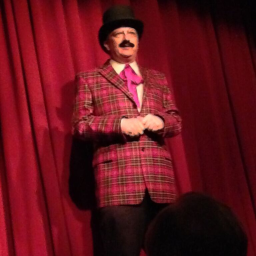
But as has ever been the case, being actually Christ-like is rarely to the taste of the men who preside over churches. At a certain point leaders put an end to the Feast of Fools, though the folk practice of playing pranks on April 1 persisted for centuries. It is of obviously of particular interest to us as Americans for in this country, hoaxing and swindling have amounted to a national ethos. P.T. Barnum and others elevated the art of the practical joke to a business model. And I find it interesting to contemplate the spectrum of wrong-doing in relation to this topic. How you go from the "entertainment" end of the spectrum (harmless, amusing pranks that make us laugh, such as one found in sideshows and dime museums)...to medicine shows and advertising (entertainment plus a squeeze that may verge on or surpass the point of larceny)...to utter deviousness: fraud, theft, and even murder (in the form of products that kill you). What do you call a dangerous hoax played on millions of people? Organized religion, consumer culture, patriotic wars? A few examples. Culminating with this guy.
Quite a leap from April Fool's Day, eh? But I like to go to these heady places. Travalanche has entire section on hoaxes, titled "BUNKUM" with over 100 posts, for the topic is very much related to our favorite themes here. I heartily recommend perusing it on this day of days. You may also be interested in learning about Humorina, an annual April Fool's Day festival in Ukraine.
Don't take any wooden nickels!


No comments:
Post a Comment